
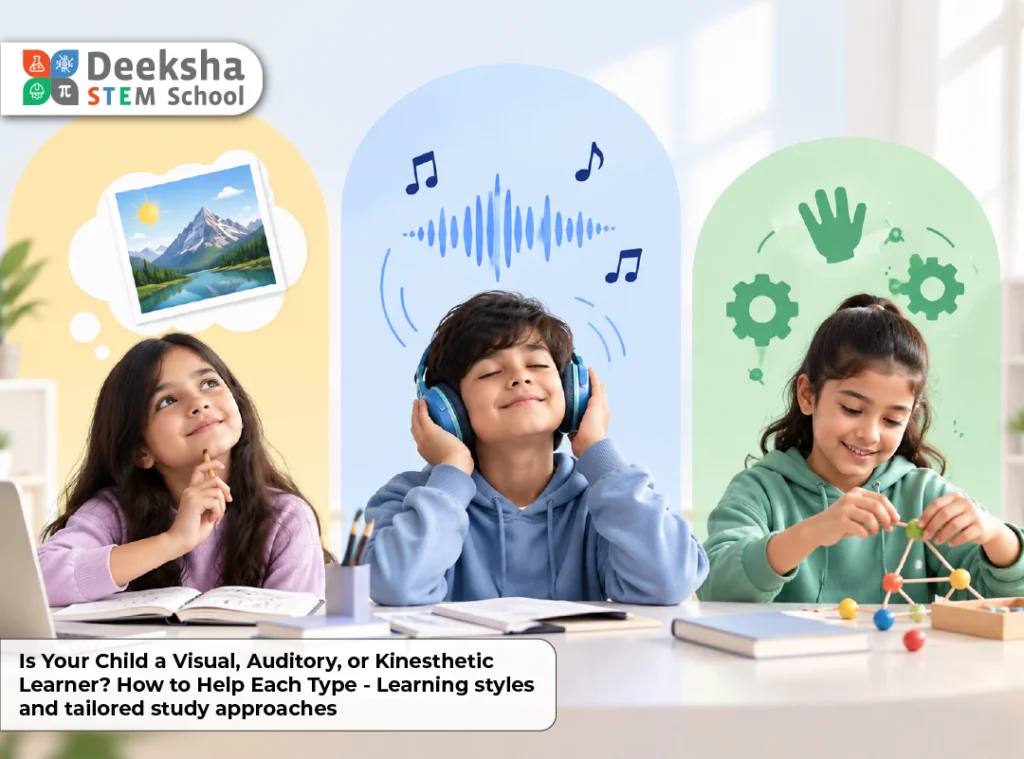
A parent takes an online quiz, gets told their child is a “kinesthetic learner,” and starts hunting for hands-on worksheets and movement-based activities, convinced this is the missing piece for better grades. It’s one of the most widely believed ideas in education. It’s also one of the most thoroughly tested and disproven, and the actual research is worth knowing before reorganising a child’s entire study routine around it.
Learning Styles: The Idea Almost Everyone Believes
The learning styles idea is simple and intuitive: every child has one dominant way of taking in information, visual, auditory, or kinesthetic, and matching how a lesson is taught to that preferred style should make learning easier and more effective. It’s genuinely everywhere, in teacher training programs, parenting articles, and school classification systems, and surveys have found that roughly 90 to 95 percent of teachers believe in it and shape their teaching around it.
Types of Learning: What the Actual Research Found
The trouble is that decades of research into these types of learning have consistently failed to find evidence for the central claim. A landmark 2008 review, published in a leading psychological science journal and since cited thousands of times, examined the research specifically testing whether matching instruction to a student’s preferred style actually improves learning, and found no credible evidence that it does. A separate systematic review examined 71 different learning style frameworks, not just visual, auditory, and kinesthetic, but dozens of other popular models, and found the evidence supporting nearly all of them was weak or nonexistent. Cognitive scientists have come to describe learning styles as a “neuromyth,” an idea that feels true and has become deeply embedded in education, despite consistently failing to hold up when actually tested.
Visual, Auditory, and Kinesthetic Learner Traits: What’s Actually True
Here’s the part worth being precise about, since the full picture is more useful than either extreme. It’s genuinely true that a kinesthetic learner, a child who prefers moving, building, or acting things out while studying, exists as a real preference, along with children who gravitate toward diagrams and images, or toward listening and talking things through. What the research actually challenges isn’t that these preferences exist, it’s the specific claim that teaching to a child’s preferred style produces better learning outcomes than teaching any other way. A child might genuinely enjoy hands-on activities more, and enjoyment matters for motivation, but studies consistently find that enjoying a particular format doesn’t translate into remembering the material better than a child taught a different way would.
Personalized Learning: What Actually Works Instead
If matching a fixed style isn’t the answer, real personalized learning looks different from what most parents have been led to expect. The strongest evidence points toward multi-modal teaching for every student, regardless of stated preference, presenting a concept visually, explaining it verbally, and letting a student engage with it hands-on, rather than picking just one channel based on a supposed type. Genuine personalization is less about sensory format and more about pacing, difficulty level, and connecting new material to a student’s actual interests, alongside proven techniques like active recall and spaced review, which help essentially all students regardless of how they’d describe their own learning preference. None of this means preference is meaningless. It just isn’t the lever that actually moves learning outcomes the way the popular version of this idea claims.
How This Fits a Deeksha STEM Classroom
This is close to what a well-designed classroom already does without needing to sort students into fixed categories first. Enquiry-based learning, learning by design, and experiential science together naturally deliver a concept through multiple channels, discussion, visual representation, and hands-on building, to every student, not a version tailored to a supposed type. That lines up exactly with what the research recommends: variety for everyone, rather than narrowing a child’s exposure to just one format based on a label. Communicative English adds a further, format-independent layer, since being able to explain a concept clearly in words is a genuine test of understanding regardless of whether a student identifies as a visual, auditory, or kinesthetic learner.
The Bigger Picture
The visual, auditory, kinesthetic framework endures because it offers something appealing: a simple label that seems to explain a child, and a clear instruction for how to help them. The actual research offers something less tidy but ultimately more useful, that genuine progress comes from variety and proven technique, not from correctly identifying which of three boxes a child belongs in.
FAQs
So learning styles don’t exist at all? The preferences themselves are real, some children do prefer visuals, discussion, or movement. What research doesn’t support is the specific claim that teaching to that preference improves how well a student actually learns compared to other approaches.
Should I stop letting my child study the way they enjoy? No. Enjoyment and comfort still matter for motivation and consistency. The key adjustment is not expecting a preferred format to be the secret to better results, and not limiting a child to only that one format when variety tends to help more.
Why do so many teachers still believe in learning styles if it’s been debunked? The idea is intuitive, feels true from everyday classroom experience, and has been embedded in teacher training for decades. Belief in a popular idea often persists well past the point research has moved on from it, which is common across many fields, not just education.
What should I actually focus on instead of identifying my child’s learning style? Favour teaching and studying that uses multiple formats together, visual, verbal, and hands-on, regardless of preference, and prioritise techniques with strong evidence behind them, like active recall and spaced practice, over matching a format to a supposed fixed type.