
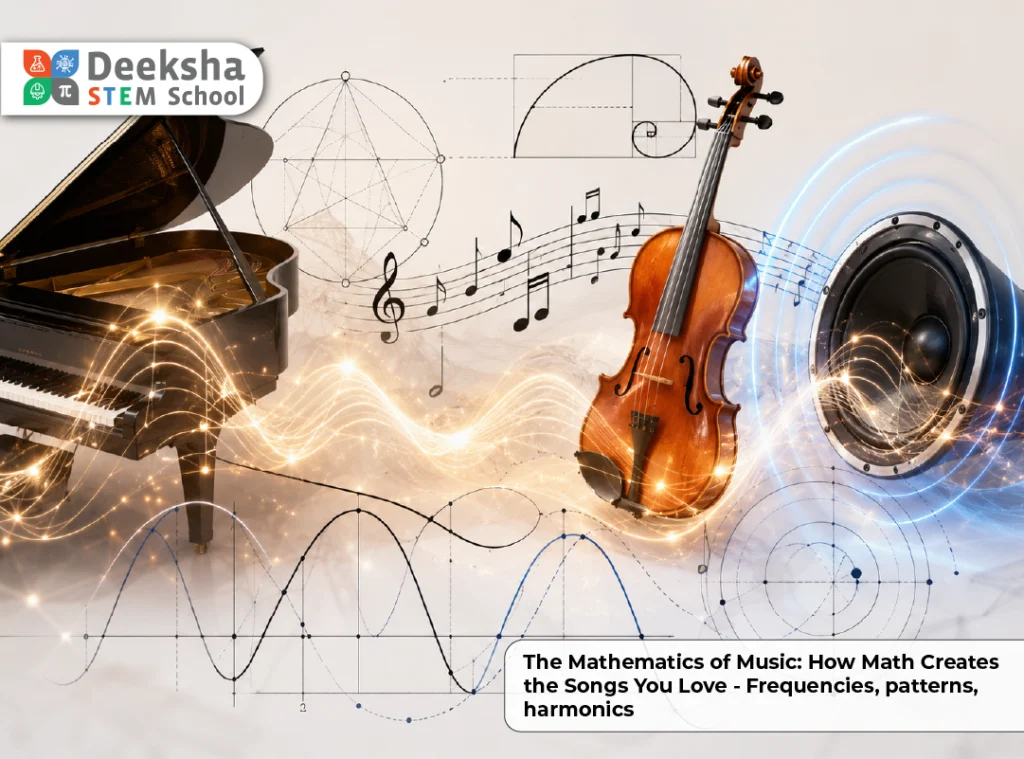
Play a favourite song and it feels like pure emotion, not arithmetic. But strip away the lyrics and the instruments, and what’s actually happening underneath is a set of numbers vibrating in specific, precise relationships to each other. Music isn’t decorated with a little math trivia on the side. It’s built on it, from the very first note.
Math in Music for Students: Where to Actually Start Looking
Math in music for students usually gets introduced as a fun fact, the golden ratio supposedly hiding in a famous symphony, that kind of thing. The real connection is far more solid and far less mystical than that: pitch, harmony, and rhythm are all, at their core, mathematical relationships, not metaphors for them.
The Mathematics of Sound Waves: What a Note Actually Is
The mathematics of sound waves starts with a simple fact: a musical note is a sound wave, a pattern of air pressure rising and falling at a specific, repeating rate. That rate is called frequency, measured in vibrations per second, or hertz. The standard tuning note most orchestras use, the A above middle C, vibrates at exactly 440 hertz, 440 pressure waves hitting your eardrum every single second. A higher frequency means a higher pitch. A larger wave, technically higher amplitude, means a louder sound. Every note that’s ever been played is, physically, just a wave repeating at a particular speed.
Frequencies and Harmonics Explained: Why an Octave Doubles
Frequencies and harmonics explained simply: when a string or column of air vibrates, it doesn’t just produce one pure frequency, it produces a whole stack of them at once, called harmonics, all mathematically related to a base frequency called the fundamental. The second harmonic vibrates at exactly twice the fundamental’s frequency. The third vibrates at exactly three times. This isn’t approximate, it’s an exact integer relationship, and it’s the reason an octave, doubling a note’s frequency, sounds like “the same note, higher” to human ears across every culture on Earth.
This same logic explains harmony more broadly. A perfect fifth, one of the most pleasant-sounding intervals in music, comes from a frequency ratio of 3:2. A perfect fourth is 4:3. A major third is 5:4. Notice a pattern: the simpler the ratio, the more naturally consonant, or pleasant, the interval sounds to most listeners. As ratios get more complex, intervals tend to sound more tense or dissonant. Composers didn’t invent this rule. They discovered it, the same way a physicist discovers a law already sitting in nature.
Harmonics also explain something else worth knowing: why the same note played on a guitar and a piano sounds noticeably different, even when both instruments are perfectly in tune. A note is never just its fundamental frequency alone, it’s a specific blend of the fundamental plus a unique mix of harmonics layered on top. That exact blend, different for every instrument, is what gives each one its distinct tone, called timbre.
Equal Temperament: The Compromise That Makes All Keys Possible
Here’s a genuinely elegant piece of applied math hiding inside every piano. If instruments were tuned using pure harmonic ratios exactly, they’d sound in tune in one key and noticeably off in any other, since those simple ratios don’t divide evenly across twelve notes. The solution, called equal temperament, divides the octave into twelve equal steps, where each note’s frequency is the previous one multiplied by the twelfth root of two, roughly 1.05946. Twelve of these multiplications in a row bring you back to exactly double the starting frequency, a perfect octave. It’s a deliberate mathematical compromise: no interval except the octave is mathematically “perfect” anymore, but every key becomes equally usable, which is exactly why a piano can switch between songs in entirely different keys without needing to be retuned each time.
Patterns in Music Mathematics: Rhythm as Fractions
Patterns in music mathematics show up just as clearly in rhythm as they do in pitch. A time signature like 4/4 is, quite literally, a fraction: four beats per measure, with the quarter note defining what counts as one beat. A whole note lasts exactly as long as two half notes, or four quarter notes, or eight eighth notes, a system of nested fractions that every rhythm in Western music is built from.
Other musical traditions build their own equally mathematical rhythmic systems. Indian classical music organises rhythm through tala, cyclical patterns of a fixed number of beats, teentaal’s sixteen-beat cycle being one of the most widely used, subdivided into smaller groupings the way a time signature subdivides a measure. Different tradition, same underlying idea: rhythm is pattern, and pattern is mathematics, whether it’s written as a fraction or counted as a cycle.
Math and Music Connection: Why This Isn’t Just a Coincidence
The math and music connection goes back further than most people realise. Ancient Greek mathematicians studying vibrating strings were among the first to notice that pleasant-sounding intervals corresponded to simple whole-number ratios, a discovery credited to Pythagoras and refined by mathematicians for centuries after. Every tuning system, every scale, every chord progression built since has, whether the composer thought about it explicitly or not, been working within the physics of harmonics discovered that early. Music wasn’t decorated with mathematics after the fact. It was built from it, sometimes deliberately, sometimes because physics simply didn’t allow any other outcome.
How This Fits a Deeksha STEM Classroom
The most useful habit this topic can build isn’t memorising which ratio makes a perfect fifth. It’s the instinct to ask why something that feels purely emotional, a chord that sounds happy or sad, might have a physical explanation underneath it, which is exactly what enquiry-based learning is meant to develop. Experiential science offers an unusually satisfying way to test this directly: stretch a rubber band or a guitar string, pluck it, then press it exactly at its midpoint and pluck again. The pitch jumps up by precisely one octave, a physical demonstration of the same 2:1 ratio driving the entire harmonic series, audible in seconds rather than read about in a textbook. And learning by design fits naturally too, since building even a simple instrument (a set of tuned bottles, a basic monochord) forces a direct, hands-on encounter with the exact math this article has been describing.
The Bigger Idea
Music doesn’t feel like math while it’s playing, and it isn’t supposed to. But the fact that emotion and precision can sit on top of the exact same numbers, that a wave repeating at a specific rate can also make a room full of people feel something, might be one of the more convincing arguments that math was never only about numbers on a page to begin with.
FAQs
Do I need to be good at math to understand music theory? Not advanced math. Most of the core relationships (octaves, fifths, basic rhythm) involve simple ratios and fractions, the same kind of thinking used in an early school math class, just applied to sound instead of numbers on a page.
Is it true that minor chords sound sad because of math? Partly. Minor chords involve a slightly more complex frequency ratio than major chords, which contributes to why they’re perceived as more tense or melancholic, though cultural association and listening habits also shape that emotional response, so it isn’t purely a mathematical effect.
What’s a simple way to actually see this math in action? Pluck a guitar string or stretched rubber band, then press it exactly at the halfway point and pluck again. The pitch will jump up by exactly one octave, a direct demonstration of the 2:1 frequency ratio.
Is a piano actually perfectly in tune? Not in the purest mathematical sense. Equal temperament, the tuning system almost all modern pianos use, slightly adjusts every interval except the octave so that every key sounds equally usable, a deliberate, practical compromise rather than a mathematically perfect tuning.