
In late 2020, scientists did something that normally takes a decade or more: they designed, tested, and rolled out a working vaccine in under a year. That speed wasn’t a shortcut on safety, and it wasn’t luck either. It was the payoff of decades of quiet research into a molecule most biology students already study without realising its full potential: mRNA.
Understanding how these vaccines actually work isn’t just background trivia. It’s a genuinely useful window into how the immune system, and modern biology, actually operates.
What Is a Vaccine, Actually?
Vaccine science for students usually starts with one simple idea: a vaccine doesn’t fight an infection directly. It trains the immune system to recognise a threat before the real thing ever shows up, the biological equivalent of a fire drill.
Traditional vaccines have done this for over two centuries using a few different strategies: a weakened version of the virus, an inactivated (killed) version, or just a harmless piece of it, enough for the immune system to learn what to look for, without the risk of an actual infection. mRNA vaccines take a different route to the same goal, and that difference is worth understanding on its own terms.
How COVID Vaccines Work: The Biology, Step by Step
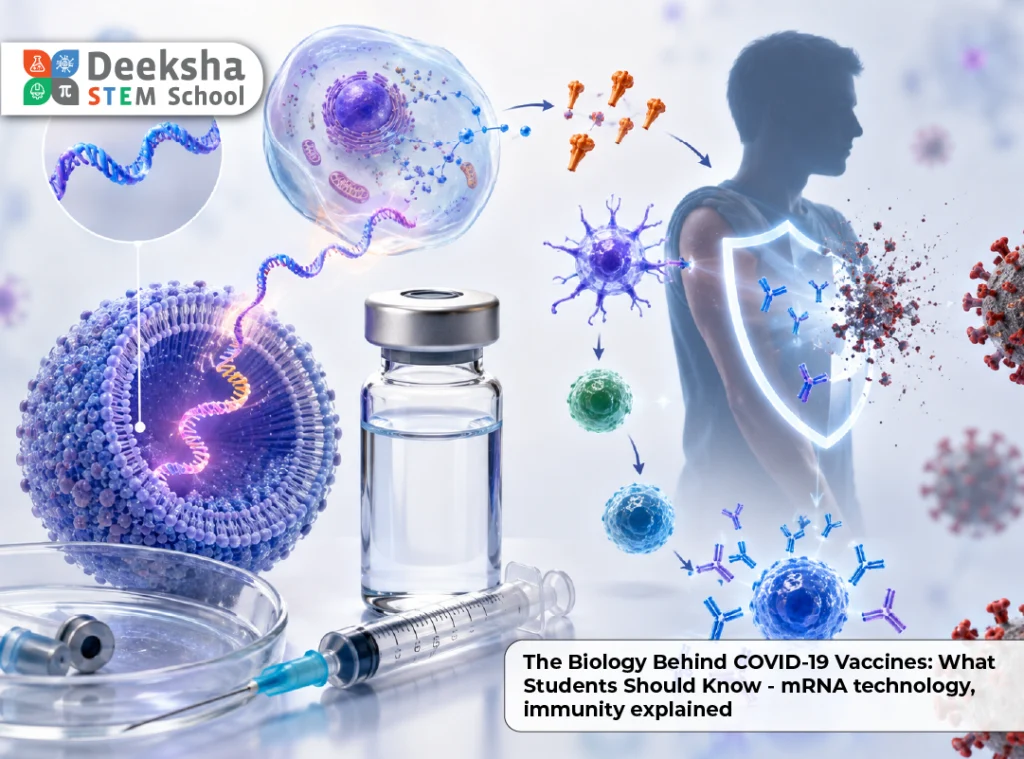
Here’s how COVID vaccines work biology, explained without the jargon. Instead of injecting a piece of the virus itself, an mRNA vaccine injects a set of instructions, a strand of messenger RNA, wrapped in a protective fatty coating so it survives long enough to reach the body’s cells.
Once inside a muscle cell, that mRNA gets read by the cell’s own ribosomes (the cell’s protein-making machinery), which follow the instructions to build one specific piece: the spike protein, the same protein that sits on the surface of the actual coronavirus and lets it latch onto human cells. Crucially, the cell only builds this one harmless piece, never the whole virus, so there’s nothing capable of causing an infection.
The cell then displays that spike protein piece on its outer surface, like a wanted poster pinned up for the immune system to notice. The immune system spots it, recognises it as foreign, and starts building a response, exactly as it would during a real infection, minus the actual illness. Within a couple of days, the original mRNA instructions are broken down and cleared out by the cell, the same way the cell disposes of its own worn-out mRNA constantly. It never enters the cell’s nucleus and never becomes part of a person’s DNA, a common point of confusion worth clearing up directly: mRNA and DNA are different molecules, kept in different parts of the cell, and the vaccine’s mRNA simply isn’t built to make that jump.
mRNA Vaccine Explained for Students: Why This Was Actually New Technology
The mRNA vaccine explained for students in one line: it’s not a new idea rushed out overnight, it’s an old idea that finally got its moment. Researchers had been studying mRNA as a vaccine platform for other diseases for years before COVID-19 arrived. What made it valuable during a pandemic was speed. Traditional vaccines often require growing large quantities of virus or protein in a lab, a slow, resource-heavy process. An mRNA vaccine just needs the correct genetic sequence, which can be designed on a computer once a virus’s structure is known, then manufactured chemically rather than grown biologically. That’s the real reason development moved faster this time, not a shortcut in testing, but a genuinely faster method of building the vaccine itself.
COVID-19 Immunity Explained: What Happens After the Shot
COVID-19 immunity explained simply comes down to memory. Once the immune system responds to that spike protein, it does two things: it produces antibodies, protein “keys” shaped specifically to recognise and neutralise that spike protein if it shows up again, and it creates memory cells, a kind of long-term immune record that sticks around long after the antibodies themselves fade.
This is exactly the same principle that makes chickenpox, once caught, rarely catch someone twice. If the actual virus turns up later, those memory cells recognise it immediately and mount a faster, stronger response than an unprepared immune system ever could, often stopping the infection from becoming severe before it gets the chance to.
The Biology of Vaccines Class 12 Style: Where This Fits Your Syllabus
The biology of vaccines Class 12 style actually maps onto this example almost perfectly. The spike protein is a textbook antigen: a foreign molecule the immune system learns to recognise. The antibodies produced in response are a direct, concrete example of humoral immunity at work. And the process of building memory cells that respond faster on a second exposure is precisely what separates active immunity (built by the body itself, whether through infection or vaccination) from passive immunity (borrowed antibodies, like those a newborn receives from its mother). A vaccine is essentially active immunity, deliberately triggered under controlled, safer conditions than an actual infection.
How This Connects to a Deeksha STEM Classroom
A topic like this is a good example of why enquiry-based learning matters more than memorising definitions. The interesting question was never just “what is mRNA,” it was “how did understanding mRNA let scientists build something this fast.” That’s the habit worth building: connecting a textbook mechanism to a real, consequential event. Learning by design shows up here too, since an mRNA vaccine is, in a real sense, a piece of biological engineering, instructions designed deliberately to produce one specific outcome. And communicative English earns its place in this topic more than most: being able to explain something as layered as an immune response in plain, accurate language, without oversimplifying it into something wrong, is a genuinely difficult and valuable skill, one this entire explanation has been trying to model.
The Bigger Picture
The pandemic turned a molecule most students had only seen in a textbook diagram into a real, working piece of technology inside millions of arms. That’s a rare, genuinely useful thing for a biology lesson to offer: not just a mechanism to memorise, but proof that understanding how a cell reads a set of instructions can, under the right circumstances, change the course of a global event.
FAQs
Can mRNA vaccines alter a person’s DNA? No. mRNA never enters the cell’s nucleus, where DNA is stored, and it isn’t built to be converted into DNA. It’s read by the cell’s protein-making machinery and broken down within days.
Why did some COVID vaccines need more than one dose? Multiple doses help build a stronger, more durable memory cell response. The first dose introduces the immune system to the antigen; a second dose reinforces that memory, similar to how repeated exposure strengthens learning in general.
Is mRNA technology only used for COVID-19 vaccines? No. Researchers were studying mRNA for other diseases well before COVID-19, and ongoing research is exploring its use for other infections and even certain cancers, using the same underlying delivery principle.
How is an mRNA vaccine different from a traditional vaccine, biologically speaking? A traditional vaccine usually delivers a weakened virus, an inactivated virus, or an already-made piece of viral protein. An mRNA vaccine instead delivers instructions, letting the body’s own cells manufacture that protein piece internally.