
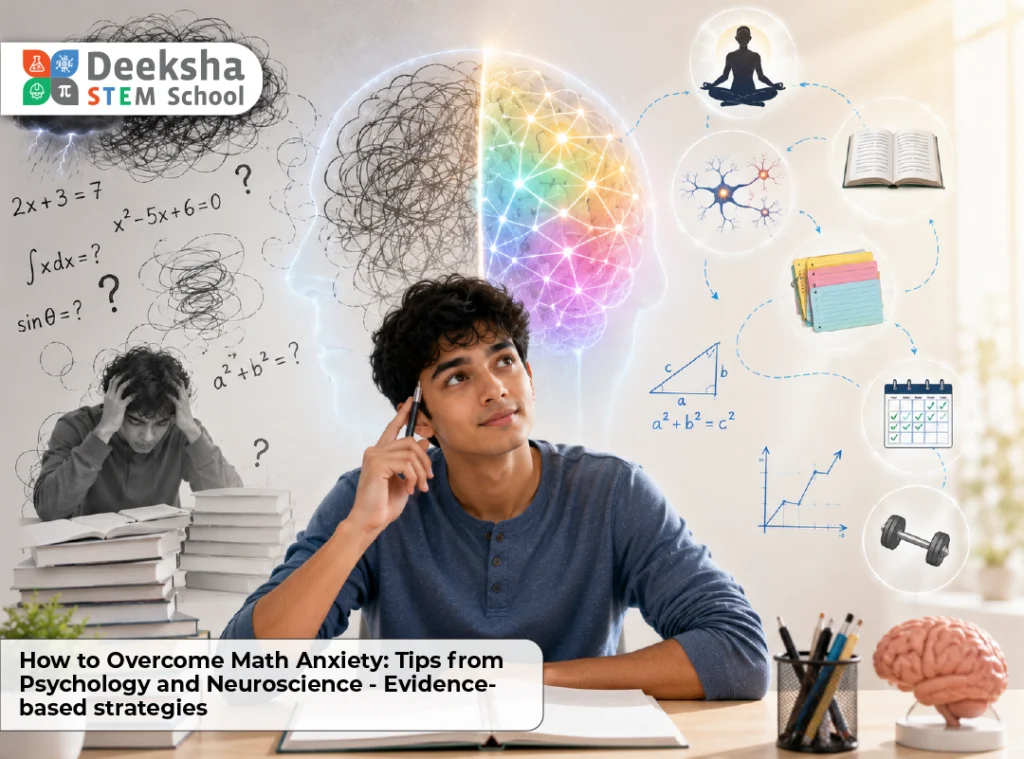
A student who explains a concept clearly in a study group can sit down for the actual test and go completely blank on the same kind of problem. Parents and teachers often read this as a knowledge gap. Researchers who study this pattern read it differently: it usually isn’t about what the student knows. It’s about what happens in their brain the moment a math problem starts to feel threatening.
That pattern has a name: math anxiety. And there’s now a meaningful body of research, from both psychology and neuroscience, on why it happens and what actually helps.
What Is Math Anxiety, and How Common Is It in Students?
Math anxiety in students is a specific, learned emotional response, a feeling of tension or dread that shows up around math tasks, distinct from anxiety in general. It isn’t the same as disliking math, and it isn’t the same as being bad at it. Some of the students most affected by math anxiety are genuinely capable at math when the anxiety isn’t triggered, which is part of what makes it so frustrating for teachers and parents to watch.
It tends to build gradually rather than appear overnight, often starting with a single bad experience (a public mistake at the board, a harshly timed test) that then generalises into a broader fear of the subject. Left unaddressed, it tends to worsen over the school years rather than resolve on its own, since avoidance of math only removes the practice that would otherwise rebuild confidence.
The Neuroscience of Math Anxiety: What’s Actually Happening in the Brain
Brain imaging research has found something genuinely striking about math anxiety: in students with high math anxiety, simply anticipating an upcoming math task activates regions of the brain associated with the perception of physical pain and threat, well before the actual problem-solving begins. The anxiety response fires during the anticipation, not necessarily during the task itself.
Separately, structural brain research in children has found that higher math anxiety is associated with differences in the amygdala, the brain’s threat-detection centre, in regions tied to fear processing. Neuroscience math learning research consistently points to the same conclusion: math anxiety isn’t a matter of willpower or attitude. It’s a measurable, physical stress response, similar in kind to other fear reactions, just triggered by a worksheet instead of an obvious danger.
The Psychology of Learning Math: Why Anxiety Sabotages Performance
Here’s where the psychology of learning math explains what the neuroscience sets up: working memory, the mental workspace used to hold numbers and steps in mind while solving a problem, is limited. Anxious thoughts (“I’m going to fail this,” “everyone else gets this”) compete for that same limited space. The more working memory gets consumed by worry, the less is available for the actual math, which is why an anxious but capable student can genuinely blank on a problem they could solve calmly a day earlier.
This creates a self-reinforcing loop. Anxiety impairs performance, poor performance under pressure confirms the fear that triggered the anxiety in the first place, and the student avoids math practice going forward, which removes the repeated exposure that would otherwise have reduced the anxiety over time. Breaking that loop is the actual goal of every evidence-based intervention that follows.
Math Fear Tips for Students: Evidence-Based Strategies
These aren’t general “stay positive” advice. Each one comes from research that measured an actual change in performance, not just how students felt afterward.
Write about the worry before the test, not during it. In a well-known study, students who spent a few minutes writing about their anxious thoughts and feelings right before an exam performed significantly better than anxious students who didn’t, especially the most anxious students in the group. The theory behind it lines up with the working memory research above: putting the worry into words frees up mental space that anxiety would otherwise be occupying during the test itself.
Reframe the physical sensation, don’t suppress it. A racing heart before a test can be interpreted two ways: as a sign of impending failure, or as the body simply gearing up for a challenge. Research on arousal reappraisal has found that students who consciously relabel that physical arousal as excitement or readiness, rather than fear, tend to perform better than students who try to calm themselves down completely, which is often harder to do in the moment anyway.
Treat mistakes as information, not verdicts. Framing an incorrect answer as data about what to work on next, rather than proof of inability, is a core finding from growth mindset research. This isn’t about empty encouragement. It’s a specific shift in how a wrong answer gets interpreted, by the student and by the adults around them.
Practice under low-stakes conditions before the real one. Since anxiety spikes hardest around unfamiliar, high-pressure moments, regular untimed or low-stakes practice tests reduce how novel and threatening the real test format feels when it actually counts.
Break problems into smaller visible steps. Since anxiety competes for working memory, reducing how much a student has to hold in mind at once (by writing out each step rather than trying to do several mentally) leaves more capacity for the actual math.
How This Shows Up in a Deeksha STEM Classroom
Several of these findings map directly onto habits already built into how a Deeksha STEM classroom runs. Enquiry-based learning treats not-yet-knowing as the normal starting point of a lesson rather than something to hide, which quietly reduces the fear of being caught out with a wrong answer. Learning by design normalises the build-test-fail-rebuild cycle, so a mistake reads as an expected part of the process rather than a personal verdict, directly supporting the growth mindset finding above. Experiential science offers the low-stakes repeated practice that research shows reduces anxiety over time, since a hands-on experiment carries less of the high-pressure weight of a written test. And communicative English plays a more direct role than it might seem: asking a student to explain their math reasoning out loud does some of the same work as the expressive writing intervention, externalising the anxious thought instead of letting it sit unspoken and consume working memory.
The Bigger Picture
Math anxiety isn’t a character flaw or a motivation problem, and treating it like one usually makes it worse, not better. It’s a well-documented, measurable response, one that research has actually figured out how to interrupt. That reframing alone (from “I’m bad at math” to “my brain is treating this like a threat, and that’s fixable”) is often the first real step toward actually overcoming it.
FAQs
Is math anxiety the same as just not being good at math? No. Research shows students with high math anxiety can be genuinely capable at math when the anxiety isn’t triggered. The anxiety interferes with performance rather than reflecting a lack of underlying ability.
Does math anxiety get better on its own over time? Usually not without intervention. Because anxious students tend to avoid math practice, the natural pattern is for the anxiety to persist or worsen, since avoidance removes the repeated exposure that would otherwise rebuild confidence.
What’s the fastest way to calm math anxiety right before a test? Writing briefly about the worry itself, just a few minutes before the test, has measurable research support and takes almost no time to try.
Can parents or teachers make math anxiety worse without realising it? Yes. Language that frames mistakes as failures, or that signals math ability is fixed rather than something built through practice, tends to reinforce the anxiety rather than ease it.