
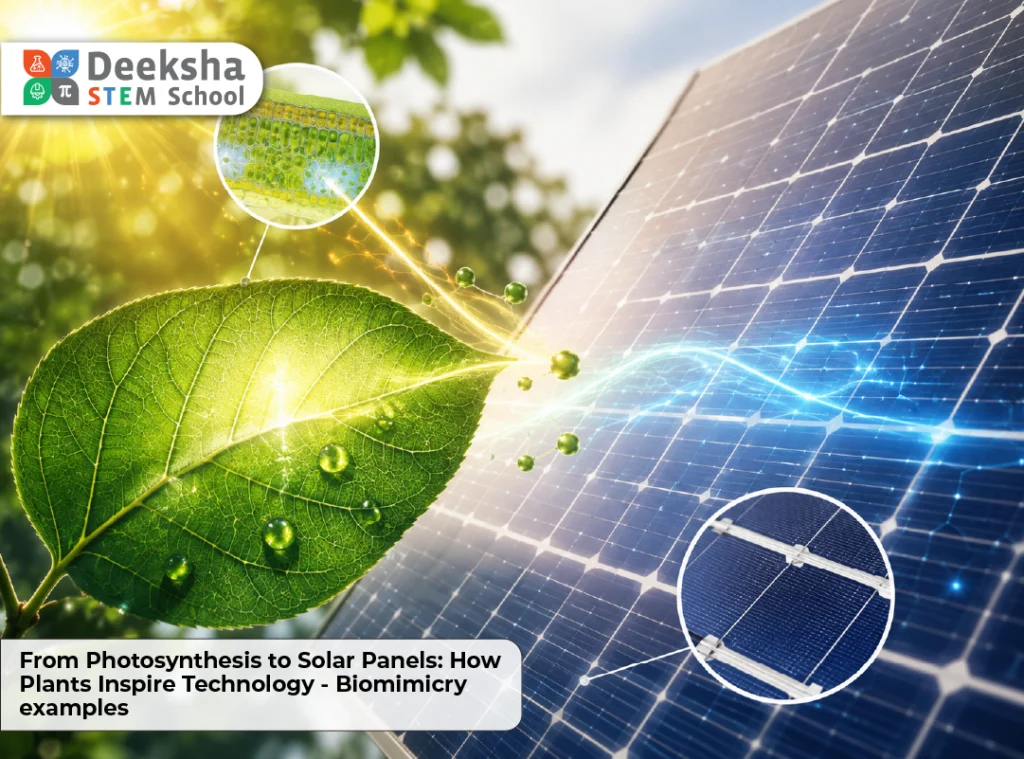
A leaf does something remarkable every single day without anyone noticing: it takes sunlight, one of the messiest, most unpredictable energy sources there is, and turns it into stored fuel, cleanly, quietly, with almost no waste. Engineers have spent decades and billions of dollars trying to build machines that come close. It turns out one of the best blueprints was growing outside the lab the whole time.
This idea, borrowing solutions that nature already spent millions of years perfecting, is called biomimicry. And once you start noticing it, it shows up almost everywhere.
What Is Biomimicry, Really?
Biomimicry for students is easiest to understand as nature’s own research and development department, minus the price tag. Every living thing on Earth has been quietly running an experiment for millions of years: survive, or don’t. The ones still around today (from a leaf to a gecko’s foot to a shark’s skin) represent solutions that actually worked, tested for longer than any human lab ever could manage.
Biomimicry is simply the practice of noticing one of those solutions and asking: could this work for us too? Not copying nature exactly, but studying the underlying idea and rebuilding it in a new form.
From Photosynthesis to Solar Panels: The Original Solar Technology
Long before anyone built a solar panel, plants had already solved the problem of turning sunlight into usable energy. That process, photosynthesis, uses a green pigment called chlorophyll to capture light and convert it into stored chemical energy the plant can use to grow. In a very real sense, a leaf is a solar panel that also knows how to repair, grow, and reproduce itself.
That connection between photosynthesis and solar energy hasn’t gone unnoticed by scientists. Researchers have built what they call an “artificial leaf,” a device designed to mimic the leaf’s structure and use sunlight to produce clean fuel, the same basic goal as photosynthesis, achieved with engineered materials instead of biology. Other researchers have studied how a leaf’s veins branch and spread to distribute water efficiently, and used that same branching pattern to design more efficient channels inside solar panels, reducing wasted energy and improving how well the panel performs. None of this means solar panels have “caught up” to leaves. Photosynthesis is still, by a wide margin, one of the most efficient energy-conversion systems on the planet. But it’s the reason solar engineers keep going back to leaves for ideas rather than starting from scratch.
Beyond Photosynthesis: Other Plant Technology Inspiration
Photosynthesis isn’t the only idea plants have handed over to human engineers. A Swiss engineer once returned from a walk to find burrs from a burdock plant stuck stubbornly to his socks and his dog’s fur. Curious why they held on so well, he examined them closely and found tiny hooks that caught onto anything with a loop-like surface. That observation became Velcro, one of the most widely used fasteners in the world.
Lotus leaves offered a different kind of insight. Their surface is covered in microscopic bumps that cause water to bead up and roll straight off, taking dirt and dust along with it. That effect, now called the lotus effect, has inspired self-cleaning paints, coatings, and fabrics that stay cleaner with far less scrubbing.
Nature-Inspired Technology Beyond Plants
Plants aren’t the only source of ideas. Nature-inspired technology draws from animals just as often. Japan’s high-speed Shinkansen train once had a design problem: it produced a loud boom every time it exited a tunnel, caused by air pressure building up too fast at the front of the train. An engineer who also happened to be a birdwatcher noticed how a kingfisher dives into water almost silently, thanks to its narrow, pointed beak, which slices through the density change between air and water. The train’s nose was redesigned to copy that shape, and the problem disappeared, along with a useful side effect: the train also became faster and more energy-efficient.
Geckos can climb straight up a smooth wall without any sticky residue, because of microscopic hair-like structures on their feet that grip using a weak molecular attraction called Van der Waals force. That mechanism has inspired reusable, residue-free adhesives. Humpback whales have small bumps along the front edge of their fins that, counterintuitively, improve how smoothly they move through water. Wind turbine blades built with the same bumpy edge pattern have shown improved efficiency and reduced noise.
More Biomimicry Examples in Science and Everyday Life
A quick round-up of biomimicry examples science has already turned into real technology, side by side with what nature figured out first:
| What nature does | Technology it inspired |
| Leaves convert sunlight into stored energy | Artificial leaves and more efficient solar cells |
| Burdock burrs hook onto fur and fabric | Velcro |
| Lotus leaves repel water and stay clean | Self-cleaning coatings and paints |
| Kingfishers dive with almost no splash | Shinkansen bullet train nose design |
| Gecko feet grip smooth surfaces without residue | Reusable, sticky-free adhesives |
| Whale fins move smoothly using bumpy edges | Quieter, more efficient wind turbine blades |
Why Biomimicry Fits Naturally With How Deeksha STEM Teaches Science
Biomimicry isn’t really a separate topic bolted onto science class. It’s closer to a mindset, and it happens to be one that’s already built into how a Deeksha STEM classroom runs. Enquiry-based learning is, at its core, the exact question every biomimicry breakthrough starts with: why does this work so well in nature, and could it work for us too? Learning by design gives students the chance to actually prototype an idea inspired by something they observed, rather than only reading about someone else doing it. Experiential science, especially close observation of real plants and specimens, is where a student is most likely to notice the kind of small detail (a leaf’s vein pattern, a burr’s tiny hooks) that has historically led to real discoveries. And communicative English matters here too: every biomimicry story worth telling depends on someone being able to explain, clearly, why a strange detail in nature actually matters.
The Bigger Idea
The most useful habit biomimicry teaches isn’t a fact about kingfishers or lotus leaves. It’s a way of looking at the world: noticing something ordinary, staying curious about why it works, and asking whether that answer might solve a completely different problem. Every example in this list started with someone willing to look a little longer at something everyone else had already walked past.
FAQs
Is biomimicry the same as just copying nature exactly? Not quite. Biomimicry usually means studying the underlying principle behind a natural solution and rebuilding it in a new material or context, not copying the organism itself.
What’s a simple biomimicry example a student could research or try at home? Velcro is one of the easiest to explore, since the burdock burrs that inspired it can often be found and examined directly, and the “hook and loop” mechanism is easy to see with a magnifying glass.
Why do engineers still study photosynthesis if we already have solar panels? Because photosynthesis remains far more efficient at converting light into usable energy than most current solar technology, so it continues to offer ideas for improving solar cells rather than being a solved, outdated model.
Does biomimicry only apply to big technology like trains and solar panels? No. It shows up in everyday products too, from self-cleaning paint to adhesive bandages, and in ongoing research areas like medicine and architecture, not just headline-making inventions.