
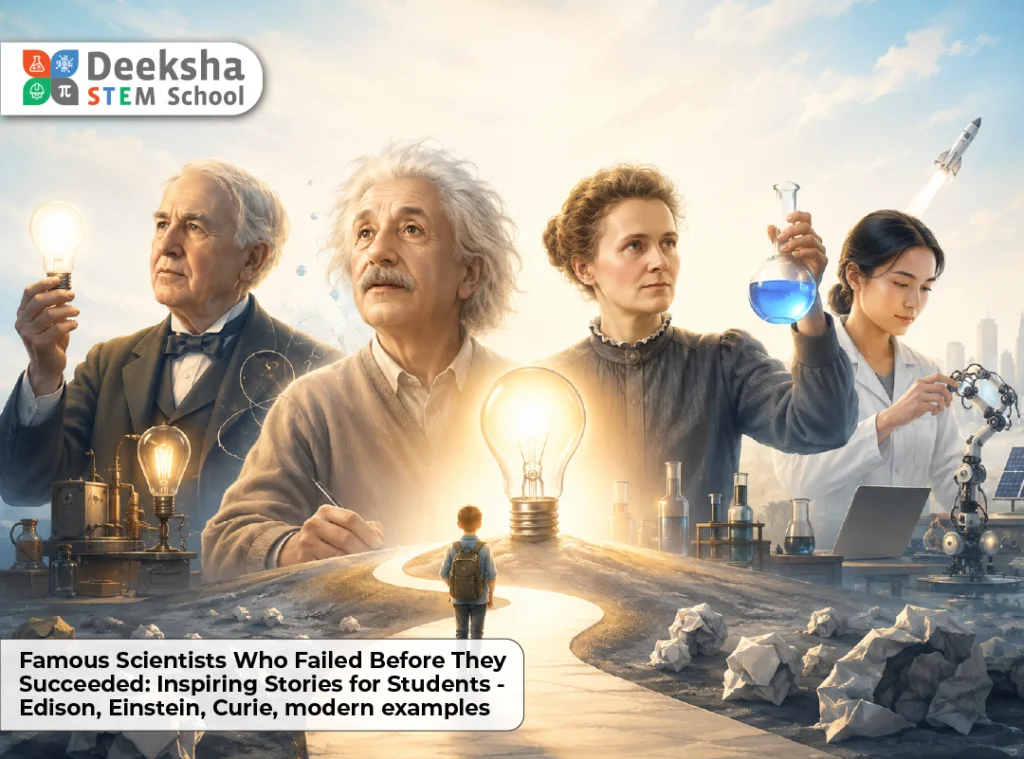
The popular version of scientific discovery usually skips straight to the breakthrough: a flash of insight, a triumphant result, history made. The real stories, once you actually check them, almost always include a much longer, far less glamorous middle section, one filled with rejection, wrong turns, and setbacks that had nothing dramatic or inevitable about them at the time.
Famous Scientist Failure Stories: Why the “Overnight Genius” Version Is Almost Always Wrong
Famous scientist failure stories tend to get smoothed over in retelling, the setback becomes a quick, dramatic obstacle rather than what it actually was: months or years of genuine uncertainty, with no guarantee the story would end well. Worth being careful here too, some of the most repeated “failure” stories about famous scientists have drifted from what actually happened into something closer to legend. The stories below stick to what’s actually documented.
Edison Einstein Failures: The Setbacks Behind Two Iconic Names
Thomas Edison’s search for a workable lightbulb filament genuinely did involve testing an enormous number of materials that didn’t work before finding one that did, and what’s most useful about the story isn’t the number itself, it’s the mindset behind it: treating each failed material as information that ruled out one option and narrowed the search, rather than as evidence that the whole project was doomed.
Albert Einstein’s story is worth telling carefully, because a popular version of it is simply false. Einstein did not fail math, at any point, and consistently scored at the top of his class in mathematics and physics. What actually happened: at sixteen, two years younger than most applicants, he failed the general entrance exam to the Swiss Federal Polytechnic in Zurich, not because of the math or physics sections, where he scored exceptionally, but because of weaker performance in subjects like French and biology. He spent an additional year studying at a school in Aarau before retaking the exam and being admitted. Even after graduating, Einstein struggled for a while to find an academic position, working at the Swiss patent office when he published the series of papers in 1905 that would eventually transform physics. The real story doesn’t need the myth. It’s more interesting as it actually happened.
Scientists Who Failed and Succeeded: The Overlooked Names Worth Knowing
Marie Curie’s path involved obstacles that had nothing to do with her ability. Barred from formal higher education in Warsaw as a woman under Russian rule, she studied through an underground institution known as the “Flying University” before eventually moving to Paris to pursue her education properly, living through real poverty in the process. Even after doing the actual scientific work on radioactivity, recognition wasn’t automatic: the original 1903 Nobel Prize in Physics nomination included only her husband Pierre and Henri Becquerel, leaving her name off entirely. It took a Swedish mathematician on the nominating committee, alerted to the omission, contacting Pierre directly, and Pierre’s own insistence that any prize include Marie, for her name to be added before the award was finalised.
A.P.J. Abdul Kalam, long before becoming known as India’s “Missile Man” and later its President, had a much simpler, more personal setback: his lifelong dream of becoming an Indian Air Force fighter pilot ended when he placed ninth out of twenty-five candidates, with only eight slots available. By his own account, it was a genuinely painful moment, one he described as reaching “the edge of a cliff” emotionally before finding a new direction, which eventually led him into the aerospace and defence research career that actually defined his life’s work.
Innovators Whose Failures Came Before Their Breakthroughs
Not every one of the more inspiring science stories for students belongs to a scientist in a lab. Arunachalam Muruganantham, a school dropout from Tamil Nadu, set out in 1998 to build a low-cost sanitary pad for his wife after noticing she couldn’t afford proper ones. His first prototype failed completely. Testing further versions cost him socially too, his wife and mother left him for a period, and his community grew suspicious of his prolonged, unconventional research, forcing him at one point to test designs on himself using a makeshift setup, since no woman in his village would risk the social stigma of helping him further. He kept refining the design anyway, eventually inventing a low-cost sanitary pad-making machine that has since been adopted across rural India, earning him a Padma Shri and a place on Time magazine’s list of the world’s most influential people.
A more recent example: biochemist Katalin Karikó spent decades having her research proposals on messenger RNA repeatedly rejected for funding, at one point even facing demotion, as the wider scientific community remained skeptical the approach would ever work. That same research became the foundation of the mRNA COVID-19 vaccines developed decades later, and Karikó was awarded a Nobel Prize in 2023 for work that had been dismissed as a dead end for most of her career.
Growth Mindset Scientists: What These Stories Actually Teach
It’s worth being honest about what growth mindset scientists like these actually demonstrate, since “just believe in yourself” isn’t really the lesson, and oversimplifying it that way undersells what actually happened. In every story here, the person treated a specific failure as specific, fixable information, which material didn’t conduct electricity well enough, which section of an exam needed more preparation, which prototype design needed a different material, rather than as a verdict on their overall worth or ability. That distinction, between “this particular attempt didn’t work” and “I am not capable,” shows up in every single case above, and it’s a far more useful, learnable habit than simply being told to stay positive.
How This Fits a Deeksha STEM Classroom
Enquiry-based learning and learning by design both treat a failed attempt as the expected middle step of the process, not an embarrassing exception to hide, which is exactly the pattern every story above actually followed. Experiential science reinforces the same thing through direct experience: a science fair project or a lab experiment that doesn’t work the first time gives a student a small, low-stakes preview of exactly the pattern Edison and Muruganantham lived through at a much larger scale. And communicative English mattered more in these stories than it might first appear, Curie’s supporters had to argue her case in writing, Kalam wrote openly about his own setback decades later, since being able to explain a setback clearly is often what turns it into a story worth learning from, rather than one quietly forgotten.
The Bigger Picture
None of these stories would be particularly inspiring if the outcome had been guaranteed from the start, and treating them that way misses what actually made them remarkable. Each one involved a real, uncertain stretch of failure, with no promise of the ending we now already know. What separated these people wasn’t the absence of failure. It was what they did with it while the outcome was still completely unknown.
FAQs
Did Einstein really fail math? No. This is a persistent myth. Einstein excelled in mathematics and physics throughout his education. He did fail a general entrance exam at sixteen, but the weak sections were French and biology, not math.
What made Edison’s approach to failure different from just being stubborn? He treated each failed material as useful information that ruled out one option, narrowing the search toward a solution, rather than treating failure as proof the entire project was doomed.
Are there Indian examples of scientists or innovators who overcame significant failure? Yes. A.P.J. Abdul Kalam missed his goal of becoming an Air Force pilot by a single rank before going on to lead India’s missile and space research programs, and Arunachalam Muruganantham endured years of social rejection and failed prototypes before inventing a low-cost sanitary pad-making machine now used across rural India.
Does persistence alone guarantee eventual success? No, and it’s worth being honest about that. Many people show the same persistence and don’t succeed. What these stories actually share isn’t stubbornness alone, but treating each specific failure as information to learn from and adjust, not just repeating the same attempt unchanged.