
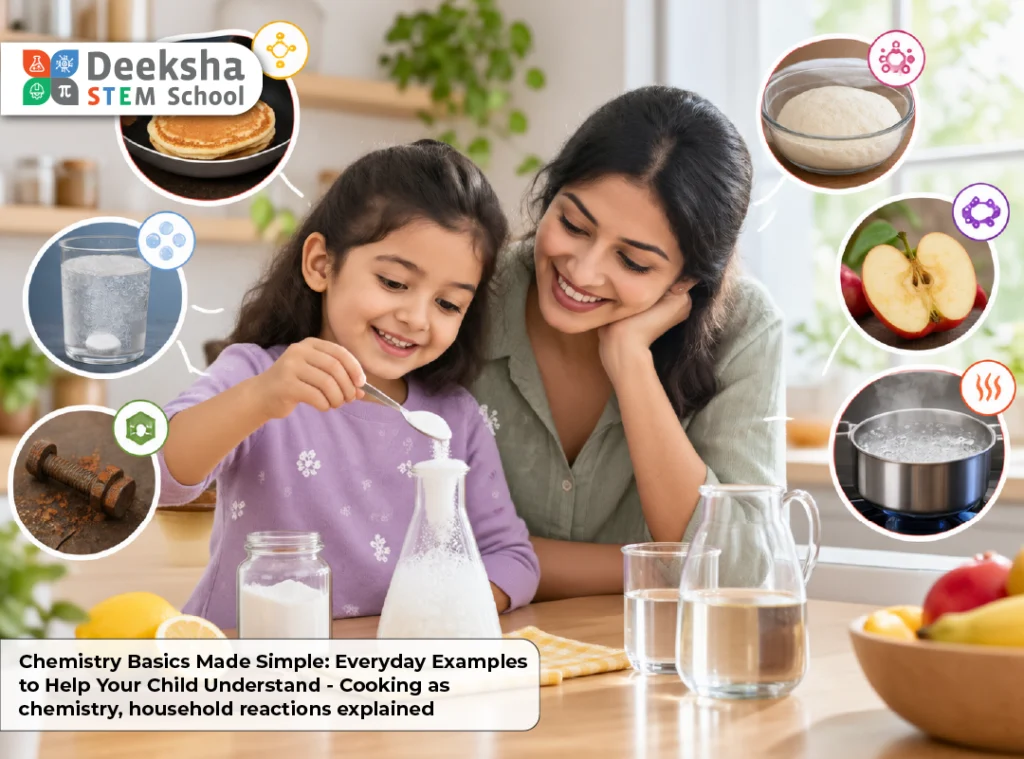
A child asks why enough times in a row, and most adults eventually run out of confident answers. What’s actually happening most of those times, whether the question is about a rusty gate, a fizzing tablet, or an egg turning solid in boiling water, is chemistry, quietly running in the background of things too ordinary to notice.
Chemistry in Everyday Life: Why It’s Easier to Spot Than It Seems
Chemistry in everyday life is easier to notice once there’s a simple test for it: has something turned into a genuinely new substance, evidenced by a colour change, a gas being released, heat appearing or disappearing, or a solid forming from a liquid, or has it just changed shape or state without becoming anything new. Ice melting into water is the second kind, a physical change, water is still water. Iron turning to rust is the first kind, a real chemical reaction, since rust is a genuinely different substance from the iron it came from. That one distinction is often enough to start spotting real chemistry in places that don’t look like a laboratory at all.
Household Chemical Reactions Beyond the Kitchen
Household chemical reactions show up well outside cooking too, and a few are worth knowing by name. Rusting is one of the slowest and most visible, iron reacting with oxygen and water over days or weeks to form a new, flaky reddish substance, easy to spot on an old gate, tool, or bicycle left out in the rain. Soap works through genuine chemistry too, its molecules have one end attracted to water and the other end attracted to oil and grease, letting it grab onto dirt that plain water would simply slide past. Dropping an effervescent tablet into a glass of water triggers a real acid-base reaction, releasing carbon dioxide gas as visible fizzing bubbles. And even a battery works by way of a genuine chemical reaction happening inside it, one that produces a steady flow of electricity as its byproduct, not a mechanical trick.
Chemistry in the Kitchen: One Genuine Example Worth Knowing
Chemistry in the kitchen deserves at least one clear example here too, and a boiling egg is one of the clearest. A raw egg’s proteins exist as tightly folded, tangled structures. Heat unfolds them, and as they unfold they bond to each other in new ways, permanently, which is exactly why a boiled egg never goes back to being liquid once it cools down again. That one-way change is called denaturation, and it’s a genuine chemical transformation, not just heat firming something up the way wax softens and hardens again reversibly.
For a closer look at exactly this kind of kitchen chemistry, from why onions make you cry to the real difference between caramelization and browning, see Why Do Onions Make You Cry? The Science Behind Everyday Phenomena.
Chemistry for Kids: How to Turn “Why” Into a Real Investigation
The most useful shift in chemistry for kids isn’t a better explanation, it’s turning the question back into something to actually check. When a child asks why a nail goes orange and flaky after sitting in the rain, the more valuable response is often “let’s leave one out and check on it every few days” rather than an immediate answer, since watching the actual change happen tends to stick far better than being told about it.
If you’re looking for ready-to-try activities like this, see 10 Easy Science Experiments You Can Do in Your Kitchen.
How This Fits a Deeksha STEM Classroom
The chain of “why” questions most children ask naturally is exactly the instinct enquiry-based learning is built to encourage rather than shut down with a quick answer. Experiential science and learning by design reinforce the same habit directly, watching a nail rust over several days or testing an effervescent tablet firsthand gives a child the same kind of evidence a real experiment provides, not just a fact to accept. And communicative English rounds it off, being able to explain what actually changed in a reaction, and why that counts as something new rather than the same substance in a different shape, is a genuine test of whether the underlying idea landed.
The Bigger Picture
Chemistry was never confined to a lab coat and a set of test tubes. It’s been quietly happening in ordinary households the entire time, in a rusting gate, a fizzing tablet, an egg turning solid on the stove. The only thing separating a curious question from a real understanding of it is whether someone stopped long enough to ask why, and then actually looked for the answer.
FAQs
How can I tell if something is a chemical reaction and not just a physical change? Look for a genuinely new substance forming, evidenced by a colour change, gas released, or a change that can’t simply be undone by reversing the temperature or pressure. Ice melting is reversible and stays the same substance. Rust forming isn’t, and is a different substance entirely.
Is it safe to explore household chemical reactions with young children? Most of the examples here, rust forming naturally, soap dissolving grease, an effervescent tablet fizzing, are safe to observe directly. Reactions involving heat or anything that shouldn’t be tasted still need adult supervision.
Do I need special equipment to show my child real chemistry at home? No. An old nail left outside, a bar of soap, an effervescent tablet, or an egg on the stove are all genuine examples, and none require anything beyond what’s already sitting around a typical home.
Why does my child ask so many “why” questions about ordinary things, and is that meaningful? It’s a genuinely good sign. That instinct, noticing something ordinary and wanting to know why it works, is the exact starting point of real scientific thinking, worth encouraging rather than answering away too quickly.