
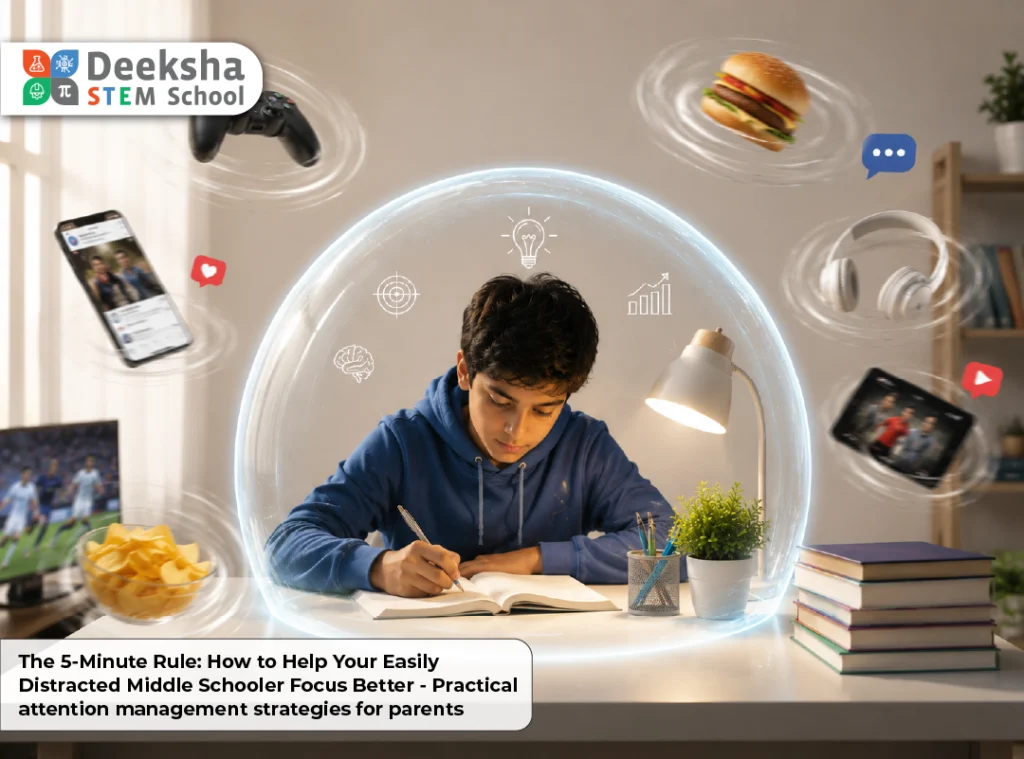
A child sits down to start homework, and twenty minutes later, nothing has actually happened, no pages turned, no pencil moved, just a slow drift toward a phone, a doodle, or a suddenly urgent need to reorganise a pencil case. It rarely comes from laziness. More often, it’s a genuine, physical struggle to cross the starting line, and the fix that works best usually isn’t about willpower at all.
Help Distracted Child Focus: Why Middle School Makes This Especially Hard
Learning how to help a distracted child focus starts with understanding why middle school specifically makes this harder than it was a few years earlier. Academic demands jump sharply around this age, more subjects, more independent work, more assignments that require sitting down and self-starting without a teacher standing right there. At the same time, the brain’s executive function system, the part responsible for planning, resisting distraction, and initiating a task, is still one of the last regions of the brain to fully mature, continuing to develop well into a person’s twenties. Middle schoolers aren’t failing at focus because they’re not trying. They’re being asked to do more independent self-management right as the part of the brain built for that job is still under construction.
Attention Management for Middle Schoolers: The Real Problem Is Usually Starting, Not Sustaining
Good attention management for middle schoolers usually needs to target a different problem than most parents assume. It’s rarely that a child can’t focus once genuinely engaged in a task, ask most kids about a video game or a hobby they enjoy, and sustained attention is clearly possible. The actual struggle is almost always at the starting line, the resistance that builds up before a task even begins. Behavioural research on this describes it as “activation before motivation”: the brain’s sense of motivation often only kicks in once a task is already underway, not before, which means waiting to feel ready or motivated enough to start is usually waiting for a signal that won’t arrive until after the starting happens anyway.
Study Focus Tips for Kids: How the 5-Minute Rule Actually Works
Among the most useful study focus tips for kids is one built entirely around that insight: the 5-minute rule. The idea is simple. Instead of asking a child to commit to finishing an entire assignment, ask for just five minutes on the specific task they’re avoiding most, with explicit permission to stop once the timer runs out if they genuinely want to. This removes the overwhelming weight of “the whole assignment” and replaces it with something small enough that starting doesn’t feel like a big decision. In practice, most children keep going well past the five minutes once they’ve actually started, since the hardest part was never the work itself, it was crossing the initial threshold into doing it. And on the days they do stop at five minutes, that’s still a genuine win, not a failure, since starting at all was the actual goal.
How to Improve Child Focus: Pairing the 5-Minute Rule With the Right Environment
Knowing how to improve child focus more broadly means pairing this technique with an environment that doesn’t quietly work against it. A phone sitting face-down nearby still pulls attention just by being visible, so moving it to another room entirely tends to work far better than trusting it to stay silenced on a desk. Working in short, clearly timed blocks, rather than an open-ended “go do your homework,” gives a concrete, visible endpoint that makes starting feel more manageable. And breaking a large assignment into small, five-minute-sized starting points, “just read the first question,” “just write one sentence,” rather than presenting it as one large, undivided task, applies the same activation principle to the assignment itself, not just to the sitting-down part.
Distracted Student Tips for Parents: What to Say and Not Say
A few practical distracted student tips for parents worth keeping in mind when this isn’t going smoothly. Avoid framing it as “why can’t you just focus,” which reads as a character judgement and tends to trigger defensiveness rather than actual movement. A more useful opener: “let’s just do five minutes on the first question together,” which lowers the stakes and offers company rather than a demand. It’s also worth watching for a different pattern: if a child genuinely can’t get started even with this technique, consistently, across different subjects, over an extended period, that’s less a five-minute-rule problem and more a pattern worth mentioning to a teacher directly, since a persistent, specific struggle like that is exactly the kind of thing worth flagging rather than continuing to manage quietly at home alone.
How This Fits a Deeksha STEM Classroom
Enquiry-based learning already applies a version of this same principle inside the classroom, opening with one small, specific question rather than an intimidating, open-ended prompt, which lowers the exact same activation barrier this article has been describing. Learning by design and experiential science do something similar in a more physical form: a hands-on project naturally breaks down into small next steps, pick up a tool, place the first piece, rather than one large abstract task, giving students repeated, built-in practice at exactly this kind of starting. And communicative English adds a useful habit on top of all this: asking a student to say out loud “what’s the very next small step” turns an internal, often overwhelming task into something concrete and spoken, which tends to make starting noticeably easier.
The Bigger Picture
A child who can’t seem to start their homework isn’t lacking discipline, they’re facing a very real, physical mismatch between what’s being asked of them and how ready their brain currently is to deliver it on demand. The five-minute rule works less because it’s clever and more because it stops asking a child to solve the hardest part of the problem, feeling ready, before they’re allowed to begin. Sometimes the easiest way past a wall is agreeing not to climb the whole thing at once.
FAQs
Is the 5-minute rule only useful for kids with ADHD? No. While it’s often discussed in that context, the underlying principle, that starting is usually harder than sustaining, applies to nearly anyone facing a task they’re avoiding, regardless of whether attention difficulties are part of the picture.
What if my child keeps stopping after exactly five minutes, every time? That’s still a genuine success, since the goal of the technique is building the habit of starting, not forcing a full session every time. Stopping is meant to be a real, honoured option, not a hidden trick to guilt a child into continuing.
Should I remind my child to use this, or wait for them to ask for help? Early on, a gentle reminder or offering to sit with them for the first five minutes tends to help more than waiting, since the whole point is lowering the barrier to start, not adding another thing they have to remember to do alone.
At what age does this kind of focus struggle usually get easier without extra strategies? Executive function continues developing well into early adulthood, so some natural improvement happens gradually through the teenage years, though most people continue to benefit from simple starting techniques like this one well into adulthood.