
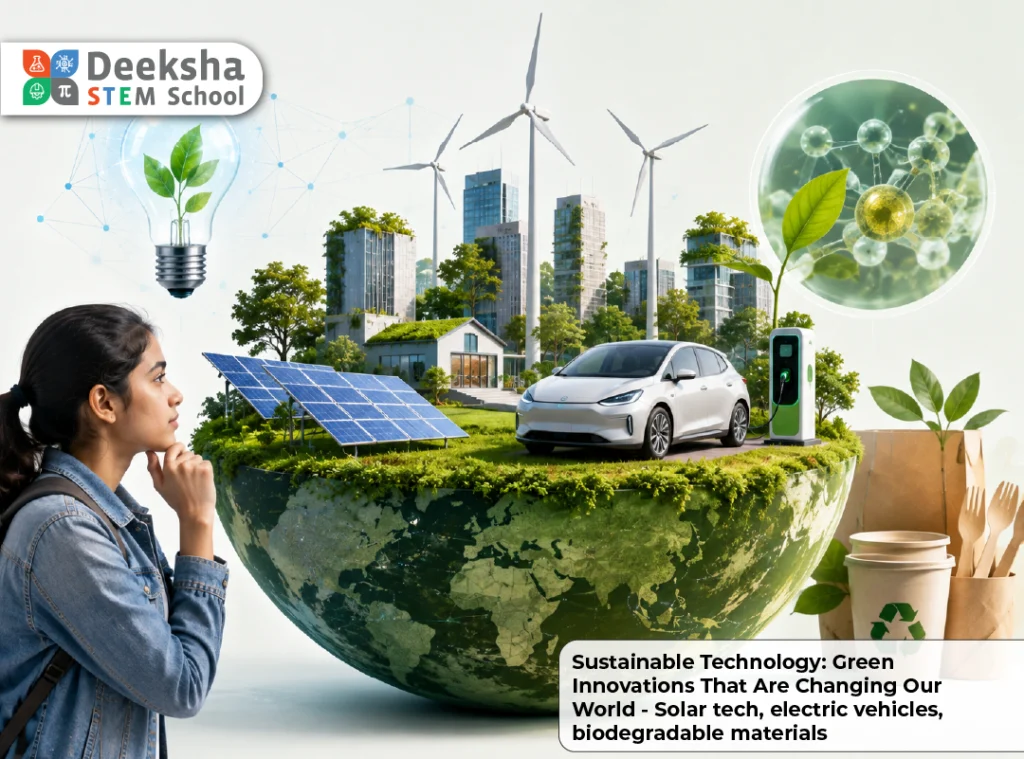
At a technology showcase earlier this year, one company unveiled a solar panel thin enough to roll up like a window blind, less than a tenth of a millimetre thick, and still capable of converting sunlight into usable electricity even indoors, under ordinary room lighting. A decade ago, that would have sounded like science fiction. Today it’s one small example of how quickly sustainable technology has moved past bulky panels and heavy batteries into something far more flexible, and far more interesting.
Green Technology Innovations: Why This Isn’t Just About Panels and Batteries Anymore
Green technology innovations used to mean one of two things: a rigid solar panel on a rooftop, or a heavy battery pack under a car. That picture is changing fast. Solar cells are becoming thin and flexible enough to wrap around a car’s bodywork. Materials scientists are growing packaging out of mushroom roots instead of manufacturing it from petroleum. The shift isn’t just about making existing green technology cheaper, it’s about rethinking what the technology looks like in the first place.
Sustainable Tech for Students: Where to Actually Start Understanding It
Sustainable tech for students is easiest to understand through one consistent question: does this reduce environmental impact while still doing the job it’s meant to do, as well or better than what it’s replacing. A solar panel that’s too expensive to install anywhere doesn’t help much. A biodegradable material that falls apart before it can actually protect a product it’s packaging isn’t a real solution either. The genuinely interesting innovations, the ones worth actually learning about, are the ones solving both problems at once, not sacrificing usefulness for the sake of being green.
Solar Energy Electric Vehicles Explained: How the Two Are Merging
Solar energy electric vehicles explained together, rather than as two separate stories, is where some of the most interesting recent progress is happening. Solar cells made from a material called perovskite are a major part of why: they’re cheaper and easier to manufacture than traditional silicon cells, and critically, they can be made thin and flexible rather than rigid. That flexibility has opened up genuinely new applications, vehicle-integrated solar being one of the most striking. Car manufacturers have started building thin, moulded solar material directly into a vehicle’s hood, roof, and trunk, without disrupting the car’s shape or aerodynamics, adding meaningful extra driving range simply from sunlight during a normal commute.
On the vehicle side, battery technology is shifting too. Newer solid-state battery designs, which replace the liquid electrolyte in a conventional lithium-ion battery with a solid one, promise longer range, faster charging, and improved safety, addressing some of the biggest remaining criticisms of electric vehicles. None of this makes solar-powered EVs fully sunlight-independent yet, the added range from built-in solar is a genuine bonus, not a replacement for charging. But it’s a real, working example of two separate green technologies, solar generation and electric mobility, beginning to merge into a single product rather than sitting in separate categories.
Biodegradable Materials Science: Packaging That Disappears on Purpose
Biodegradable materials science is solving a different problem entirely: what happens after a product is used and thrown away. Conventional plastic resists breaking down for decades, sometimes centuries, because its molecular structure isn’t recognisable to the bacteria and fungi that normally decompose organic waste. Biodegradable materials are deliberately engineered so that natural decomposers can actually break them apart.
Mycelium packaging is one of the more striking examples: agricultural waste, leftover plant stems and husks, gets bound together by mycelium, the thread-like root network of fungi, growing through it and fusing it into a solid, foam-like structure strong enough to replace polystyrene in protective packaging. Once it’s served its purpose, it breaks down completely in home compost within four to six weeks, leaving no plastic residue behind, and actually enriching the soil it decomposes into. Other approaches take a different route: PLA, a bioplastic made from corn starch, and edible films made from seaweed, designed to either compost naturally or simply be eaten along with the product, eliminating the waste question entirely.
Eco-Friendly Technology Trends: The Bigger Pattern Worth Noticing
Eco-friendly technology trends across solar, transportation, and materials all seem to be converging on the same underlying idea: build sustainability into the core design of a product, rather than adding it as an afterthought. A solar panel that’s flexible enough to become part of a car’s body isn’t solar power added to a car, it’s a car redesigned around the idea that its own surface can generate energy. Mycelium packaging isn’t ordinary packaging with a green label attached, it’s packaging rebuilt from the ground up to disappear completely once it’s no longer needed. That shift, from adding a green feature onto an old design to rethinking the design itself, is arguably the more important trend than any single new material or battery.
How This Fits a Deeksha STEM Classroom
Asking why a plastic bottle survives in a landfill for centuries while a mushroom-based container disappears in weeks is exactly the kind of question enquiry-based learning is meant to provoke, and it leads directly into real polymer chemistry rather than a surface-level fact. Learning by design and experiential science offer an unusually direct way to explore this hands-on: comparing how different packaging materials actually decompose over time in a simple compost setup turns an abstract claim about biodegradability into something a student can observe for themselves. And communicative English matters here more than it might seem, since sustainable technology is full of genuine trade-offs, cost versus impact, performance versus environmental safety, that are worth understanding clearly enough to explain, not just repeat as a slogan.
The Bigger Picture
None of these technologies are finished products in their final form, and treating them that way would actually undersell how fast this space is still moving. What connects a rollable solar curtain to a mushroom-grown shipping box is a shared willingness to question a design that’s been accepted as “normal” for decades, rigid solar panels, plastic that never decomposes, and ask whether it was ever the only option to begin with.
FAQs
Are perovskite solar cells actually available to buy yet, or still experimental? Both, depending on the application. Some flexible, low-power perovskite products for small electronics have already reached the market, while larger-scale rooftop and vehicle applications are still moving through further stability and durability testing before wide commercial rollout.
Is biodegradable the same as compostable? Not quite. Biodegradable generally means a material will break down naturally over time, while compostable specifically means it breaks down within a defined period under composting conditions into non-toxic material that can enrich soil, a more specific and often more rigorously tested claim.
Do electric vehicles with built-in solar panels actually run entirely on sunlight? Not yet. Vehicle-integrated solar currently adds meaningful extra range from passive sunlight exposure during normal driving or parking, but it supplements charging rather than replacing it entirely.
What’s the biggest challenge holding these technologies back from wider mainstream use? Largely cost and long-term durability at scale. Many of these materials and cells perform impressively in smaller or newer applications, but manufacturing them cheaply and reliably at the scale needed to replace existing plastic or silicon-based systems remains the harder, ongoing challenge.