
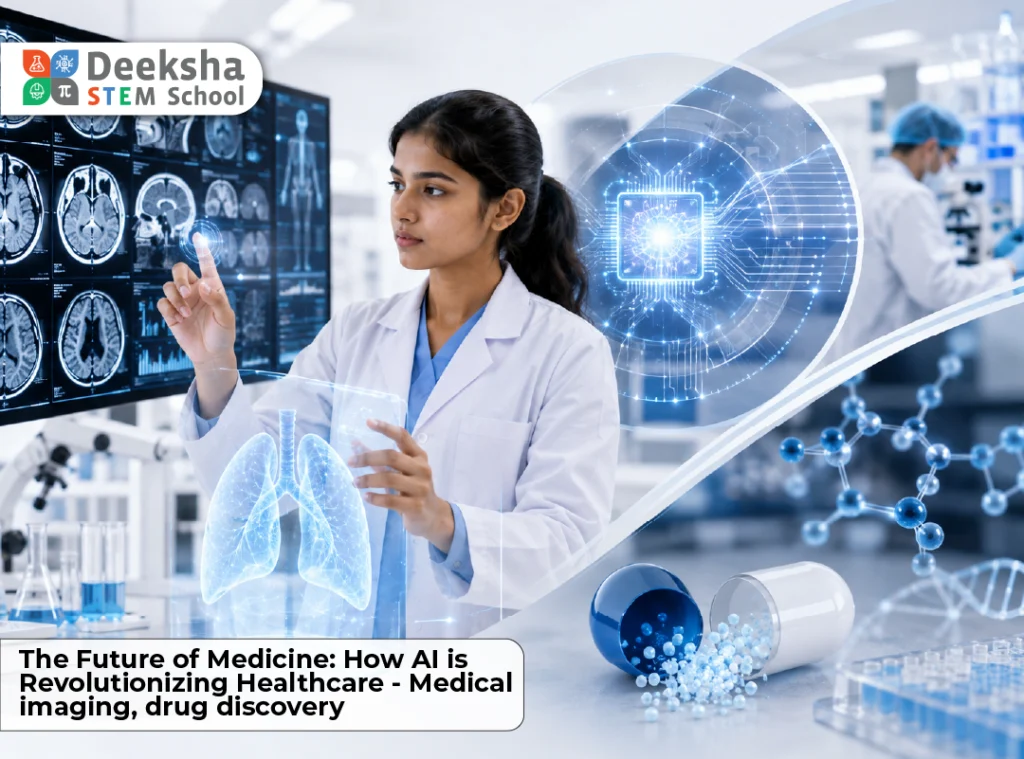
Somewhere in a hospital right now, a piece of software is looking at a retinal scan or a chest X-ray, flagging something a radiologist should look at more closely. This isn’t a preview of medicine’s future. Over 1,500 AI-enabled devices have already been authorised for use in the United States alone, most of them quietly working inside radiology departments today. The genuinely interesting story isn’t that AI is coming to medicine. It’s that parts of it are already here, and other, more hyped parts are still very much a work in progress.
AI in Healthcare Explained: Two Very Different Kinds of Progress
The future of medicine for students to actually understand, rather than just repeat as a headline, splits into two areas that get talked about as if they’re at the same stage, when they really aren’t. Medical imaging is the mature, already-deployed success story, regulated, tested, and used in real clinical settings today. Drug discovery is the genuinely exciting but still unproven frontier, full of promising early results and, as of today, not a single fully approved medicine to its name yet. Both matter. Confusing where each one actually stands leads to either dismissing real progress or overselling something still years away.
Artificial Intelligence Medical Imaging: The Part That’s Already Working
Artificial intelligence medical imaging works, at its core, on pattern recognition: an AI model trained on enormous numbers of labelled scans learns to spot specific visual patterns, sometimes catching subtle signs a busy or fatigued human reviewer might take longer to notice. This has become the single most mature area of medical AI, and radiology makes up the large majority of all FDA-authorised AI medical devices, largely because digital imaging data has existed in large, structured quantities for decades, giving these systems exactly the kind of data they need to learn from.
Real, working examples already exist. One system became the first autonomous AI diagnostic tool cleared to screen for diabetic retinopathy without a specialist needing to review every image first. Another became the first AI application authorised specifically in pathology, helping identify signs of prostate cancer in tissue samples. This isn’t experimental technology anymore, it’s operating inside real clinical workflows, under real regulatory oversight. It’s worth being fair about the limits too: researchers have pointed out a gap between how quickly the number of approved AI devices is growing and how deep the clinical evidence behind each one actually runs, a reminder that regulatory clearance and rock-solid proof aren’t always the exact same thing.
AI Drug Discovery: A Genuinely Promising Field Still Proving Itself
AI drug discovery tells a very different, more honest story right now. One of the clearest recent breakthroughs, a system that predicts a protein’s three-dimensional shape directly from its genetic sequence, solved a problem that used to take researchers months or years per protein, compressing it down dramatically. Since a drug typically works by binding precisely to a specific protein shape, that breakthrough gave drug researchers a genuinely powerful new starting point.
But a starting point isn’t a finished drug. As of mid-2026, no medicine discovered or designed by AI has received full regulatory approval anywhere. The furthest-advanced candidate, developed by a company using AI throughout its discovery process, only entered a late-stage Phase III clinical trial in July 2026, promising results so far, but still years from any possible approval, and clinical trials fail more often than they succeed, regardless of how a drug was discovered. Some researchers studying the field have raised a fair, more skeptical point too: AI-discovered drug candidates so far have progressed through trials at roughly similar rates to traditionally discovered ones, meaning AI’s clearest proven benefit right now is speeding up the early discovery phase, not necessarily improving the odds of a drug actually working once it reaches human trials.
Learning From What Didn’t Work: The IBM Watson Lesson
It’s worth remembering a well-known cautionary example here too. An earlier, heavily publicised AI system built to recommend cancer treatments was eventually discontinued after internal reviews found it had, in some cases, suggested treatments oncologists themselves flagged as unsafe. The system was eventually sold off entirely. The lesson isn’t that AI in medicine doesn’t work, the imaging examples above show clearly that it can. The lesson is that “it’s AI” was never, on its own, a good enough reason to trust a medical recommendation, then or now, and rigorous, independent validation matters more than confident marketing.
Healthcare Technology Career: Where Students Actually Fit Into This
A healthcare technology career in this space increasingly rewards people who genuinely understand both sides of it, enough biology or medicine to know what a clinically meaningful result actually looks like, and enough computer science or data literacy to know what an AI model can and can’t reliably do. That combination is still relatively rare, which is exactly what makes it a strong direction for a STEM-minded student to consider: roles in medical imaging AI development, clinical validation of health AI tools, and the regulatory science needed to actually get these systems safely approved are all growing areas that didn’t meaningfully exist as career paths a decade ago.
How This Fits a Deeksha STEM Classroom
The IBM Watson example above is really a lesson in enquiry-based learning applied to real stakes: asking “how do we actually know this is right,” rather than accepting a confident-sounding output at face value, is precisely the habit that separates a useful medical AI tool from a dangerous one. Learning by design mirrors how these systems actually get built in the real world too, an early version, tested rigorously, revised, and tested again, rather than trusted immediately on a first attempt. And communicative English plays a genuinely practical role in this exact field: a doctor or researcher who can clearly explain what an AI tool’s recommendation means, and doesn’t mean, to a patient who isn’t technical, is doing work every bit as important as the engineering behind the tool itself.
The Bigger Picture
The honest version of “AI is revolutionizing healthcare” is less dramatic than the headline version, and more genuinely interesting for it. Parts of it, particularly in medical imaging, are already real, tested, and working inside hospitals today. Other parts, especially drug discovery, are showing real promise without yet having delivered a single finished, approved result. Knowing the difference between the two isn’t a minor detail. It’s the difference between understanding this field and just repeating what a headline claimed about it.
FAQs
Has an AI actually discovered a drug that’s available to patients right now? Not yet. As of mid-2026, no AI-discovered or AI-designed drug has received full regulatory approval anywhere. The most advanced candidate is still in a late-stage clinical trial, with approval, if it happens, still likely a couple of years away.
Can AI replace doctors for diagnosis? Not currently, and the most successful tools today are designed to assist a clinician’s judgement, flagging things worth a closer look, rather than replacing the clinician’s decision entirely. Even the most advanced approved imaging tools operate within a defined, narrow task, not general medical judgement.
Why is AI further along in medical imaging than in drug discovery? Largely because of data. Decades of structured, digital medical images already existed for imaging AI to learn from, while drug discovery involves far messier, more complex biological systems and years-long clinical trials that can’t be shortened just because a candidate was found faster.
What actually went wrong with IBM Watson for Oncology? Internal reviews found the system had, in some instances, recommended treatments that oncologists considered unsafe, largely tied to how it had been trained. It was eventually discontinued and sold off, a widely cited example of why rigorous, independent validation matters more than a system’s underlying reputation.