
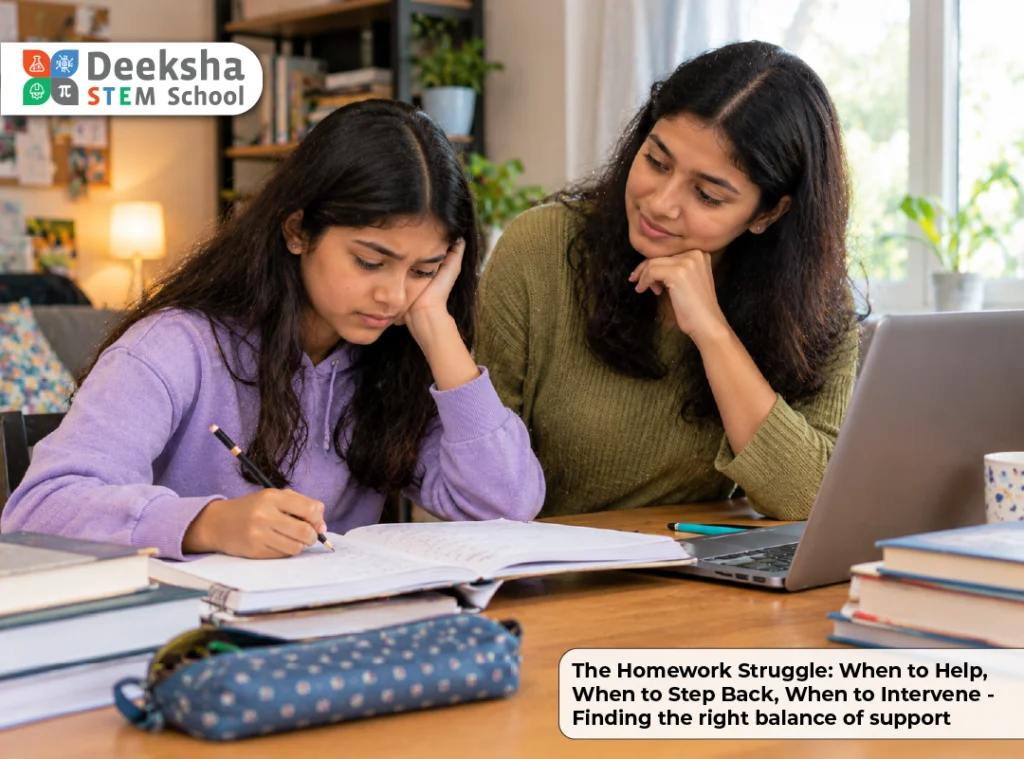
A child sits stuck on a problem, pencil tapping, visibly frustrated, and a parent hovers nearby facing a familiar, uncomfortable choice: jump in and just show them, or hold back and let them work through it. Both instincts come from the same place, wanting the child to succeed, and both, taken too far, can quietly work against that same goal.
When to Help Child With Homework: The Real Question Isn’t “Should I”
Deciding when to help child with homework isn’t really a yes-or-no question, even though it often gets treated like one. The more useful question is how much help, and what kind. Educational psychologists describe this using a concept called the zone of proximal development: there’s what a child can already do completely alone, what they can do with a bit of the right support, and what remains out of reach even with help, for now. The most useful kind of homework help lives specifically in that middle zone, not the first, and not the third.
Homework Support Balance Parents Actually Need: Why Both Extremes Backfire
Finding the right homework support balance parents can actually stick to matters because both extremes cause real problems, just in different ways. Stepping in too early, giving the answer, working the problem for them, correcting every small error immediately, robs a child of the exact struggle where learning actually happens, and can quietly mask a real gap in understanding from the one person best placed to help close it, the teacher, who never gets to see it show up on its own. Research looking specifically at parents’ beliefs about this found a meaningful relationship between how much parents valued this kind of productive struggle and how their children’s math ability was reported, a reminder that a parent’s instinct about when to step back genuinely matters, not just how much time gets spent helping.
The opposite extreme causes different damage. Leaving a child to struggle well past the point of useful effort, past frustration into real distress, doesn’t build resilience, it usually just teaches a child that homework is a source of anxiety with no reliable support available when they actually need it.
Stepping Back From Homework Help: What Productive Struggle Actually Looks Like
Stepping back from homework help doesn’t mean disappearing. It means shifting from giving answers to asking questions that let a child find the answer themselves. Instead of solving the problem, a simple prompt like “what do you notice about this one” or “what strategy worked on the last problem like this” keeps the thinking with the child, while still signalling that support is right there if it’s needed. This is what researchers call productive struggle: effort spent making sense of something just beyond a child’s current ability, which is precisely the condition under which real learning happens, not before it and not long after frustration sets in.
A few minutes of visible frustration on a genuinely challenging problem isn’t a warning sign. It’s usually the struggle actually doing its job.
How Much to Help With Homework: A Practical Way to Decide in the Moment
The question of how much to help with homework gets easier with a simple, repeatable check in the moment. First, has a real attempt actually been made, a few focused minutes of genuine effort, or is this a “haven’t really tried yet” pause. Second, would a guiding question unlock it, or does the underlying concept itself need re-explaining, in which case reteaching the whole topic the night before it’s due usually isn’t the right fix, flagging it to the teacher the next day often is. Third, is the frustration still productive, engaged, mildly annoyed, still trying, or has it tipped into real distress, tears, shutting down, refusing to continue, which is the point to pause the whole session and come back to it later, not push through.
Homework Struggle Parent Guide: When It’s Actually Time to Flag a Teacher
A useful homework struggle parent guide rule of thumb: an occasional hard night is normal and doesn’t need anyone’s attention beyond a parent’s patience. A pattern that repeats on the same specific topic, night after night, week after week, despite consistent effort and reasonable support at home, is worth mentioning to the teacher directly, not something to keep quietly managing alone at the kitchen table. A teacher seeing the same struggle independently in class is genuinely useful information, and a teacher who’s never heard about a recurring struggle at home can’t do anything to help address it.
How This Fits a Deeksha STEM Classroom
A classroom built around enquiry-based learning already models the exact instinct parents are being asked to practice at home: ask a question before supplying an answer, and let a student do the reaching. Learning by design goes a step further, since building or designing something almost always involves a version that doesn’t work at first, giving a very concrete, low-stakes example of what productive struggle actually looks like in practice, one a parent can point to directly when a child feels discouraged over a stuck homework problem. And communicative English plays a quiet but real role too: a child who’s used to explaining their own reasoning out loud in class tends to respond naturally to a parent’s “what do you notice” question at home, since it’s the same habit, just in a different room.
The Bigger Picture
The instinct to help a struggling child is exactly the right instinct. The only real adjustment worth making is what that help actually looks like, less about supplying the answer, more about staying close enough that a child never feels alone in the struggle, without ever taking the struggle away from them entirely. That balance is harder to hold than either extreme, but it’s also where most of the actual learning happens.
FAQs
How long should I let my child struggle before stepping in? There’s no fixed number, but a few minutes of genuine, focused effort is a reasonable starting point. The better signal to watch for is whether the struggle still looks engaged and effortful, or has tipped into real frustration and shutdown, which is the actual moment to step in or pause.
Is it bad to just give my child the answer sometimes? Not as an occasional choice, especially late at night or under real time pressure. The concern is when it becomes the default response to any difficulty, since that’s what removes the struggle where learning happens, not any single instance of it.
How do I know if my child needs a tutor rather than just more independent practice time? If a specific topic keeps causing struggle over several weeks despite consistent effort and reasonable support at home, that’s a good moment to raise it with the teacher first, who can help clarify whether it’s a practice gap or something needing more structured, specialist support.
What if helping with homework always turns into an argument? That’s often a sign the help being offered doesn’t match what’s actually needed in the moment, frequently too much correction, too fast, rather than space for the child to attempt it first. Shifting from giving answers to asking guiding questions often reduces the friction considerably, since it changes the dynamic from correction to collaboration.