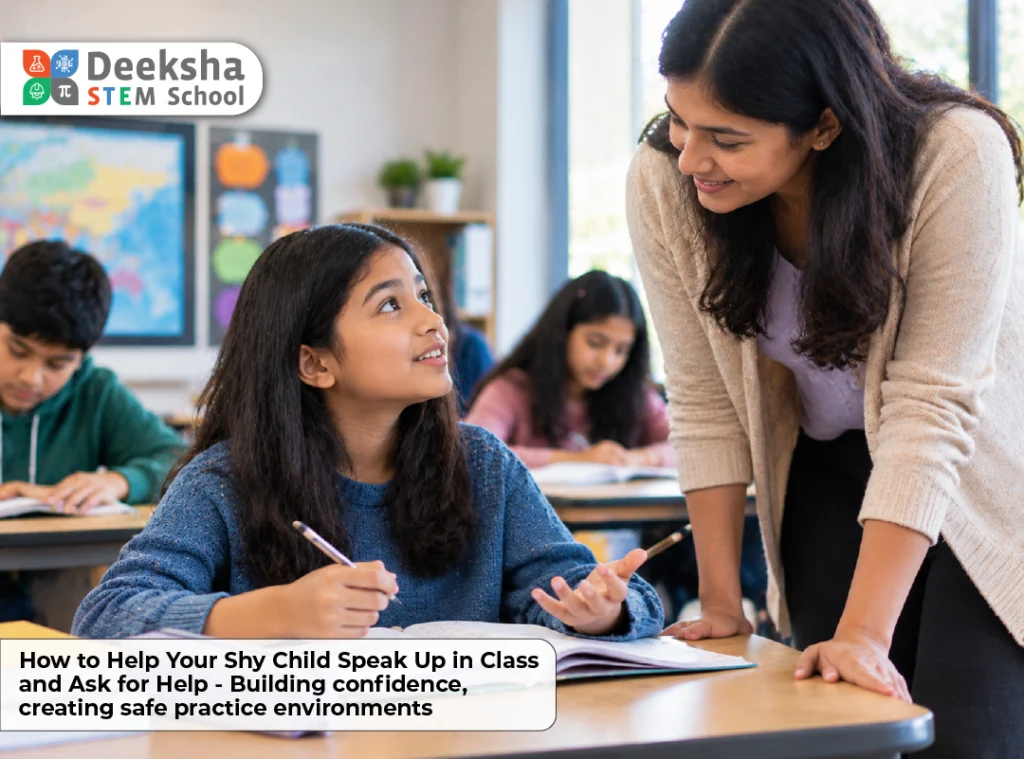
A child understands the material perfectly at home, explains it clearly to a parent over dinner, and then sits in class the next day, hand nowhere near raised, question left unasked, even when genuinely confused. It’s one of the more frustrating gaps a parent can watch play out, not a knowledge problem, but something quieter getting in the way.
Shy Child Speak Up in Class: Why This Isn’t About Fixing a Flaw
Helping a shy child speak up in class starts with a reframe worth sitting with: shyness isn’t a flaw that needs correcting, and the goal was never to turn a quiet child into an outgoing one. Shyness is, at its core, a wariness about being judged or getting something wrong in front of others, not a lack of ability or a personality defect. The actual goal is narrower and more achievable: giving a child real tools to participate on terms that don’t require becoming someone they’re not.
Introverted Child in Classroom: Shy Isn’t the Same as Introverted
An introverted child in a classroom and a shy one can look identical from the outside, quiet, not raising a hand, but the reason underneath is often completely different, and getting that distinction right changes what kind of help actually makes sense. Introversion is a temperament, a preference for solitude and quieter environments because they feel energising rather than draining, not driven by fear. A shy child, by contrast, often genuinely wants to participate, but hesitation, specifically the fear of being wrong or judged, holds them back. An introverted child who quietly reads during group time may simply be recharging, not struggling. A shy child staying silent despite wanting to answer is a different pattern entirely, and it’s the one worth actively supporting.
Building Confidence in Shy Students: What Actually Works
Building confidence in shy students works best through low-pressure rehearsal, not by pushing a child straight into the highest-pressure version of speaking up. One classroom technique with real research behind it is often called “turn and talk”: before answering in front of the whole class, students discuss the question briefly with just one partner first. That small rehearsal step, saying the answer out loud to one person before saying it to thirty, measurably increases how willing students are to then share with the larger group, since the idea has already been tested once in a much safer setting. Similarly, when teachers use random or rotating questioning consistently, as an expected norm rather than an occasional surprise, shy students tend to prepare more and participate more, since the unpredictability of “will I get picked” is replaced with the more manageable certainty of “I will get picked eventually, so I should be ready.”
Help Shy Child Ask Questions: Small Steps That Actually Lower the Barrier
Helping a shy child ask questions specifically, as opposed to just answering when called on, usually needs its own set of smaller steps. Writing a question down first, even just a few words, before saying it out loud gives a child something to lean on rather than having to formulate and speak at the same time. Approaching a teacher individually after class, rather than raising a hand mid-lesson in front of everyone, removes the audience entirely while still getting the question answered. Starting within a small group before attempting a whole-class question builds the same confidence in smaller, more manageable doses. And noticing and praising the act of asking itself, not just whether the question was a “good” one, reinforces the behaviour a parent actually wants to see more of.
Building Classroom Confidence Kids Actually Feel, Not Just Perform
Building classroom confidence kids genuinely carry with them, not just a performance for one lesson, sometimes requires looking at the environment itself, not only the child. Research has found that teachers, often unintentionally, tend to expect less both socially and academically from shy students compared to their more outgoing peers, simply because quiet students are harder to read and easier to underestimate. Separately, studies have found that shy students often perform well on group-administered assessments but notably worse on individually administered ones, a pattern that says more about testing format and comfort than about actual ability. Both findings are worth a parent gently raising with a teacher directly: not as a complaint, but as a genuine question about whether a child’s quietness might be masking understanding a teacher hasn’t fully seen yet.
How This Fits a Deeksha STEM Classroom
Structured paired discussion before a whole-class share, the “turn and talk” approach described above, sits naturally inside enquiry-based learning, which is already built around discussing a question before arriving at an answer together. Learning by design and experiential science both offer something particularly useful for a shy child specifically: a hands-on project or lab task gives a way to demonstrate real understanding through building or doing, without needing to speak up cold in front of a full classroom first. And communicative English, treated deliberately as a skill built gradually rather than a personality trait to overcome, mirrors exactly the approach this article has been describing: practice in safer, smaller settings first, extended outward only once it feels manageable.
The Bigger Picture
A shy child isn’t a problem waiting to be solved. They’re a child who often already knows the answer and simply needs a safer first step before saying it out loud. Give them that first step enough times, in a small group, on paper, one-on-one after class, and speaking up in front of everyone else tends to stop feeling like the giant leap it once was.
FAQs
Is my child just introverted, or actually anxious about speaking in class? A useful test: does your child seem content and unbothered during quiet, independent moments, or do they seem to want to participate but visibly hold back out of worry. The first points toward introversion, which doesn’t need fixing. The second points toward shyness, which can genuinely be supported with practice.
Should I ask the teacher to stop calling on my child unexpectedly? Not necessarily to stop entirely, since predictable, consistent questioning (rather than occasional surprise questioning) has actually been shown to help shy students prepare and participate more. Worth discussing with the teacher how questioning is currently structured, rather than asking for it to be removed altogether.
How can I help my child feel comfortable asking for help without singling them out? Practicing at home first, writing a question down before saying it aloud, and encouraging a one-on-one conversation with the teacher after class rather than a hand raised mid-lesson, are all ways to lower the pressure without requiring any special classroom accommodation.
Will my shy child eventually grow out of it, or does this need active support? Some shyness does ease naturally with age and repeated positive experience, but active, low-pressure practice tends to speed that process considerably rather than waiting for it to resolve entirely on its own.