
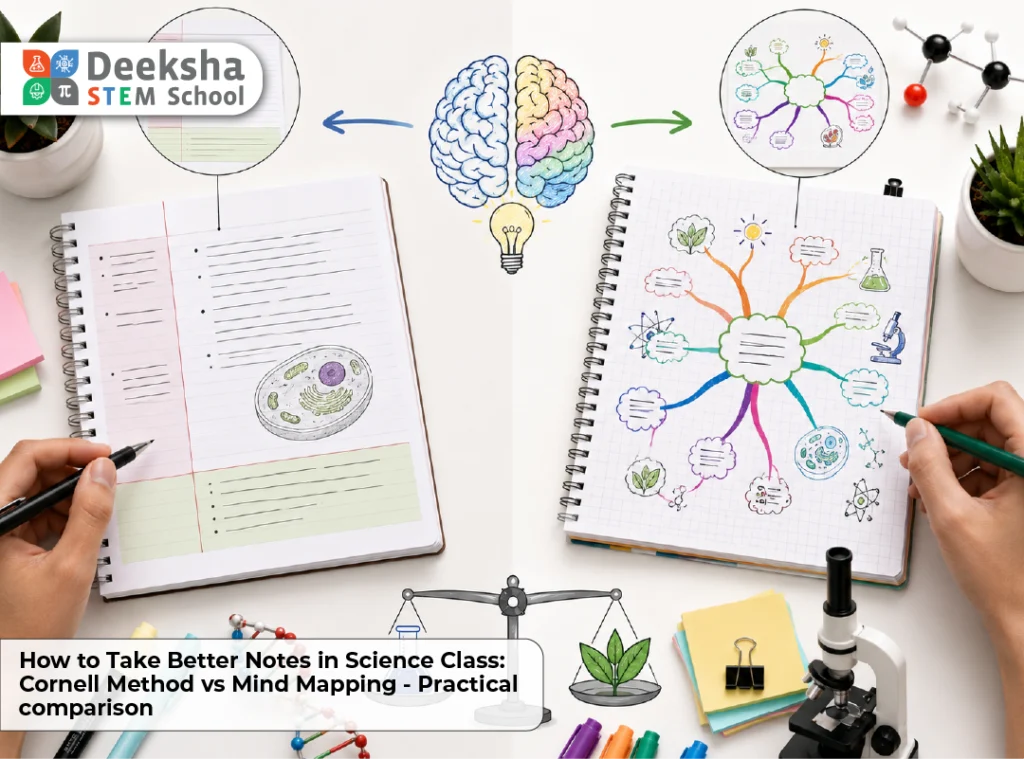
Most students take notes the same way regardless of subject: write down what the teacher says, in the order it’s said, and hope it makes sense during revision. That approach works reasonably well for history. It falls apart for science, where one idea often depends on three others, and a linear page of bullet points hides those connections instead of showing them.
Two methods solve this differently: the Cornell Method and mind mapping. Neither is universally better. The right one depends on what kind of science content is in front of you.
Why Note-Taking Actually Matters in Science Class
Science subjects build vertically. Understanding resistance depends on understanding current, which depends on understanding charge. A note-taking system that just records facts in sequence doesn’t capture that dependency, so revision becomes rereading a list rather than seeing how ideas connect.
Good notes do two jobs at once: they record what was taught, and they show the structure underneath it. That second job is where most note-taking habits quietly fail, and it’s exactly where Cornell and mind mapping take different approaches.
The Cornell Method: A Structured Way to Take Science Notes
Cornell method notes for students split a page into three sections. A narrow left column for cues (keywords or questions), a wider right column for notes taken during class, and a summary strip at the bottom filled in afterward.
Here’s how it plays out in a science class. During the lecture, the right column fills up with the actual content: definitions, diagrams, worked examples. After class (ideally the same day), the student goes back through the notes and writes short questions or keywords in the left column for each block of notes. Later, covering the right column and trying to answer just from the cues becomes a built-in self-test. The bottom summary forces a two- or three-sentence version of the whole page, which is often where real understanding shows up or doesn’t.
The method rewards discipline more than creativity. It works best for content that’s genuinely sequential: a step-by-step numerical method, a defined process like the stages of mitosis, or a topic with clear cause-and-effect chains.
Mind Mapping: A Visual Way to Take Science Notes
Mind mapping starts from the opposite instinct. Instead of a linear column, a central concept sits in the middle of the page, with branches radiating out to related ideas, each branch splitting further as the topic gets more specific.
For a topic like the human circulatory system, a mind map might start with “circulatory system” at the centre, branch into “heart,” “blood vessels,” and “blood,” and then split each of those further into their own components and functions. The visual layout does something a Cornell page can’t: it shows which ideas sit close together and which are more distant, at a glance.
The trade-off is that mind maps demand more thinking during creation. A rushed mind map, drawn in the middle of a fast-moving lecture, tends to be messier and less useful than a rushed Cornell page, because the structure has to be built in real time rather than added afterward.
Cornell Notes vs Mind Mapping: Which Wins for Which Content
Neither method is strictly better. The mind mapping vs Cornell notes comparison usually comes down to what the topic actually looks like.
| Situation | Better fit | Why |
| Step-by-step numerical problems (physics derivations, chemical equations) | Cornell Method | Sequential structure matches the content |
| Interconnected concepts (ecosystems, organ systems, circuit networks) | Mind Mapping | Visual layout shows relationships a list can’t |
| Fast-paced lecture, limited time to think during class | Cornell Method | Structure can be added after class, not during |
| Revision before an exam, reviewing a full chapter | Mind Mapping | Whole-topic view helps spot gaps in the big picture |
| Definitions and terminology-heavy topics | Cornell Method | Cue column doubles as a built-in flashcard system |
Many students who use both methods well don’t pick one and abandon the other. They take Cornell notes during class, when speed and structure matter most, then convert the summary sections into a mind map during revision, when seeing the whole topic at once matters more.
Science Class Note-Taking Tips: Choosing or Combining the Two
A few practical rules make either method work better. Fill in the Cornell cue column and summary the same day, not a week before the exam. It only works as a memory test if enough time has passed to actually forget some of it. For mind maps, resist the urge to make them tidy on the first attempt. A messy first draft that captures the right connections is more useful than a neat one drawn from a half-remembered lecture.
For lab-based topics, a hybrid often works best: Cornell notes to record the actual procedure and observations, and a small mind map afterward to connect the result back to the underlying concept it was meant to demonstrate.
Best Note-Taking Strategies for Students Beyond the Method Itself
The method matters less than a few habits around it. Reviewing notes within 24 hours dramatically improves retention compared to reviewing them just before a test. Rewriting a summary in one’s own words, rather than copying the teacher’s phrasing, is what actually reveals whether a concept was understood. And comparing notes with a classmate after a class often surfaces gaps neither of them noticed alone, since two students rarely miss the exact same thing.
The Bottom Line
Neither the Cornell Method nor mind mapping is the “correct” way to take science notes. They solve different problems: one imposes structure on a fast-moving class, the other reveals connections a linear page can’t show. The students who take the best notes usually aren’t the ones who picked a side. They’re the ones who learned to notice which kind of content they were looking at, and reached for the right tool accordingly.
FAQs
Which method is better for exam revision, Cornell or mind mapping? Mind mapping tends to work better close to an exam, since it shows the whole topic and makes it easier to spot weak spots. Cornell notes are usually more useful earlier, while the content is still being learned.
Can I use both methods for the same subject? Yes, and many students find this the most effective approach: Cornell notes during class for speed and structure, then a mind map during revision to see how everything connects.
Is mind mapping too time-consuming for a fast-paced science class? It can be, if attempted in real time during a lecture. A safer approach is Cornell notes during class, followed by a mind map built afterward from those notes.
What’s the single most important science class note-taking tip? Review and complete the notes the same day they’re taken. Whatever method is used, notes revisited within 24 hours are retained far better than notes left untouched until revision season.