
A student can watch a 12-minute YouTube video on resistance, nod through it, and feel completely on top of the topic. Then a teacher asks one follow-up question, “Why does resistance increase in a longer wire?”, and the confidence disappears.
That gap between recognising an idea and understanding it is where most STEM revision quietly fails. It’s also exactly what the Feynman Technique was built to close.
What Is the Feynman Technique?
The Feynman learning method is named after physicist Richard Feynman, who worked on the principle that if you can’t explain something simply, you haven’t actually understood it yet.
Unlike revision methods built around rereading or highlighting, the Feynman Technique doesn’t ask “did I cover this topic?” It asks “can I teach this topic?” — a much harder, much more honest question, and one that maps directly onto how STEM subjects are actually examined.
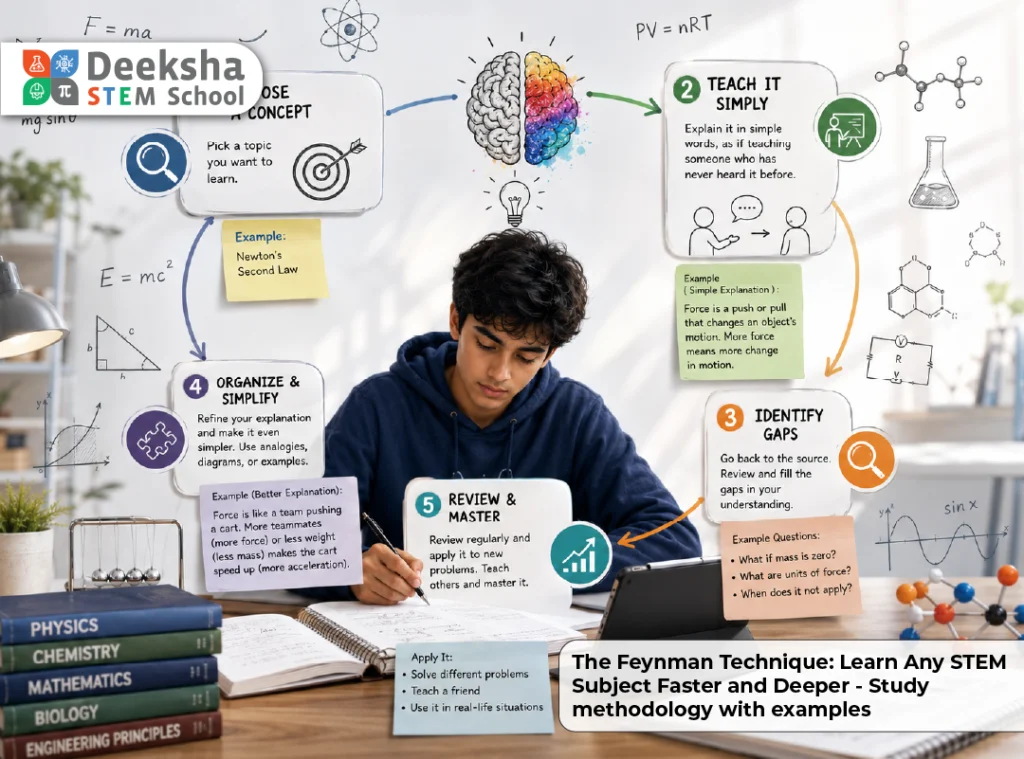
The Four Steps: How to Study STEM Effectively
Step 1: Pick One Concept, Not a Chapter
Not “electricity,” pick “why current stays the same in a series circuit.” Narrow scope is what makes the next three steps possible.
Step 2: Explain It in Plain Language
Explain it the way you’d explain it to a Class 6 student, with no textbook phrasing allowed. “Current is the rate of flow of charge” is a definition. “Current is how much charge moves past a point every second, like counting cars passing a signal” is an explanation. Only one of those survives a follow-up question.
Step 3: Find Where You Get Stuck
The moment you hesitate, that’s the actual syllabus. Not the parts you can recite, the parts you can’t yet explain. Most students read that hesitation as failure, but It’s feedback.
Step 4: Go Back and Simplify Again
Return to the source, but only for the specific gap. Re-explain it. Repeat until the explanation holds up without you reaching for jargon to cover a hole in the logic.
Feynman Technique in Action: A STEM Example
Take photosynthesis. A first-pass explanation might sound like: “plants make food using sunlight, water, and carbon dioxide.” Reasonable start.
Then comes the harder question: “why do you need chlorophyll and sunlight — why not just one?” If that stalls you, you’ve found the actual gap in ninety seconds, instead of discovering it in an exam three weeks later. That’s the entire value of the method — it converts vague unease about a topic into one specific, fixable sentence.
Why This Ranks Among the Best Study Techniques for Science
Physics, Chemistry, Biology and Math aren’t collections of independent facts — each idea sits on top of the last one. Miss resistance, and Ohm’s Law gets shaky. Miss Ohm’s Law, and circuit problems become guesswork.
The Feynman Technique works well for STEM specifically because it forces students to test the links between ideas, not just recall the ideas themselves. It bundles together several habits that, individually, are already proven to work:
| Traditional revision | Feynman-based revision |
| Reread the chapter until it feels familiar | Explain the chapter until it survives a follow-up question |
| Confidence built on repetition | Confidence built on demonstrated understanding |
| Gaps discovered in the exam | Gaps discovered during revision |
| Revise everything equally | Revise only what you couldn’t explain |
Active Recall Study Methods: Why Explaining Beats Rereading
Active recall — retrieving information from memory rather than passively reviewing it — is one of the most well-evidenced study methods there is, and the Feynman Technique is essentially active recall with a built-in accuracy check. Rereading tells you what’s familiar. Explaining out loud, to an imagined audience, tells you what you actually know. The two feel similar in the moment and produce very different results in an exam.
How This Already Shows Up in a Deeksha STEM Classroom
The Feynman Technique isn’t a study hack layered on top of a conventional syllabus; at Deeksha STEM Schools, the same instinct is already built into how a class runs, through four pillars:
Enquiry-based learning. Instead of opening a topic with the definition, a Deeksha STEM classroom often opens with a question the students have to work toward answering themselves, which means they’re doing Step 2 and Step 3 of the Feynman method before the “technique” is ever named.
Learning by design. When a concept is taught through building or designing something — a circuit, a structure, a model — a student can’t fake their way past a gap. If they don’t understand why the current needs a complete loop, the model simply won’t work. The design process does the diagnostic work of Step 3 automatically.
Experiential science. A lab demonstration or hands-on experiment forces the same recall-and-explain loop: predict what will happen, watch what actually happens, explain the difference. That’s the Feynman cycle, run as a physical experiment instead of a mental one.
Communicative English. The Feynman Technique lives or dies on the quality of the explanation — and that’s a language skill as much as a science one. Building strong communication alongside STEM content means students can actually articulate the gap they’ve found, not just sense that one exists.
None of this requires a student to separately “add” the Feynman Technique to their routine — it’s closer to how the classroom already asks them to think.
Common Mistakes Students Make
Rereading a chapter multiple times and mistaking familiarity for mastery. Memorising a definition without testing whether it can survive a follow-up question. Watching explainer videos passively, without ever attempting the explanation independently. The most common trap of all: assuming that recognising the right answer on a multiple-choice question means you could have produced it from scratch. Exams reward the second thing, not the first.
Final Thought
The more useful question before an exam isn’t “how many hours did I study?” It’s “how well can I explain what I studied?” That second question is uncomfortable to ask — and that discomfort is exactly why it works.
FAQs
Is the Feynman Technique useful for all STEM subjects, or mainly Physics? It works anywhere ideas build on each other, which covers Physics, Chemistry, Biology, and Math equally. It’s less useful for pure memorisation tasks like vocabulary or dates.
How long does one Feynman Technique cycle take? For a single concept, 10–15 minutes is usually enough to surface a gap and re-explain it — that’s the point of narrowing the scope in Step 1.
What’s the difference between the Feynman Technique and active recall? Active recall is the broader category. Any method that involves retrieving information rather than rereading it. The Feynman Technique is a specific, structured version of active recall that adds a built-in check: if the explanation doesn’t hold up in plain language, the gap is obvious immediately.
Can this replace regular revision, or should it be used alongside it? It works best alongside regular revision, as a way to decide what to revise. Use it after a first pass through a topic to find out which parts actually need another look.