
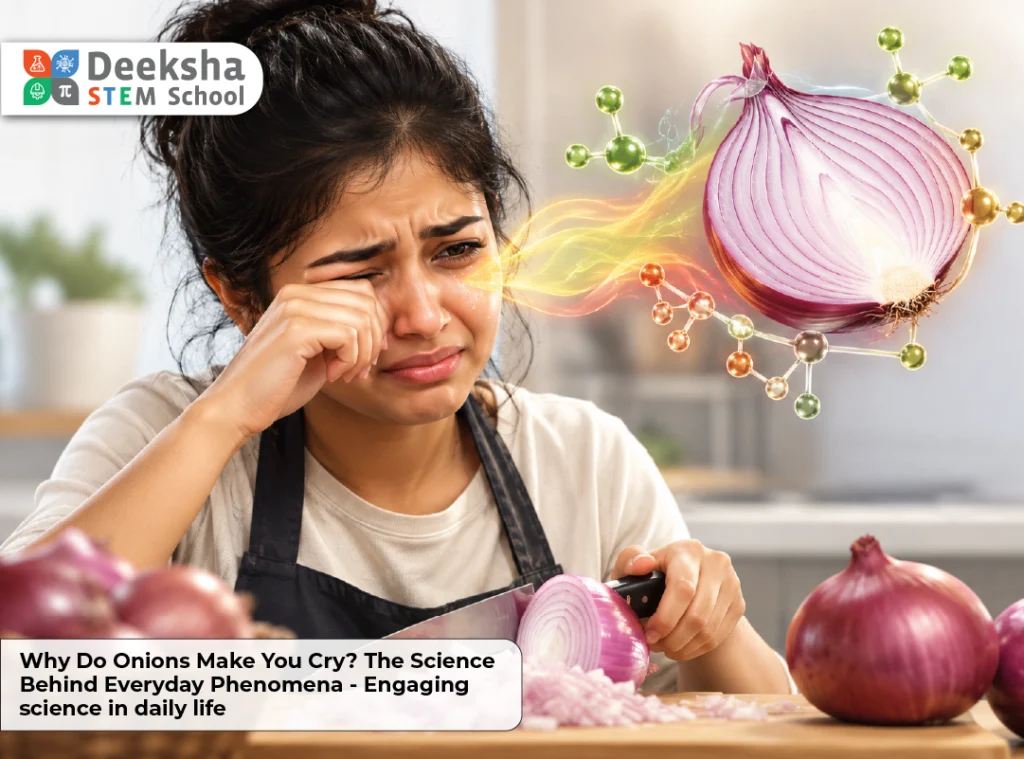
Somewhere in every kitchen, someone is chopping an onion with their face turned away, eyes already stinging, well before the tears actually start. It’s such a universal experience that most people stop asking why somewhere around age seven and just accept it as one of cooking’s small taxes. Which is a shame, because the actual answer is a genuinely well-designed piece of plant chemistry, and it took scientists until the early 2000s to fully work it out.
Why Do Onions Make You Cry? The Actual Chemistry
Why do onions make you cry? Science actually has a precise, two-step answer, and it took researchers until the early 2000s to work out the full mechanism. For decades before that, the textbook explanation was incomplete. Scientists knew an enzyme called alliinase was involved, released the moment an onion’s cells are damaged by a knife, but the full picture only came together when Japanese researchers identified a second enzyme in 2002, one nobody had known to look for.
Here’s the actual sequence, the real why do onions make you cry science answer, worked out step by step. Slicing an onion ruptures its cells, releasing alliinase, which breaks down sulfur-containing compounds stored inside the onion into unstable substances called sulfenic acids. That second enzyme, called lachrymatory factor synthase, immediately grabs those sulfenic acids and rearranges them into a gas called syn-propanethial S-oxide, the actual irritant. Because it’s a gas, it rises straight off the cutting board toward your face. When it reaches your eyes, it dissolves into the thin, watery film covering them and forms a mild solution of sulfuric acid, which is exactly as unpleasant as it sounds to your cornea. Your brain reads this as a threat and floods the eye with tears to flush it out. The crying isn’t a side effect. It’s your eye’s defence system working exactly as intended.
Knowing the mechanism also explains why the usual kitchen fixes actually work. Chilling an onion before cutting slows the enzymes down, since enzymes react faster at warmer temperatures. A sharp knife causes less cell rupture than a dull one, meaning less gas released in the first place. And cutting near a fan or open window simply disperses the gas before it reaches your eyes. None of these are old wives’ tales. They’re small, correct applications of the same chemistry causing the problem.
Everyday Science Phenomena Explained: More Kitchen Mysteries
Onions aren’t the only overlooked chemistry experiment happening in a kitchen. A few more everyday science phenomena explained, once you actually look:
Why bread rises. Yeast, a living microorganism, feeds on sugars in the dough and releases carbon dioxide gas as a byproduct. That gas gets trapped in the dough’s stretchy gluten network, forming the air pockets that make bread light instead of dense.
Why toast smells so good. That smell is the Maillard reaction, a chemical process where proteins and sugars on the bread’s surface react under heat, producing hundreds of new flavour and aroma compounds. The same reaction is responsible for the smell of seared meat and roasted coffee.
Why ice floats instead of sinking. Most substances get denser as they cool. Water does something unusual: as it freezes, its molecules lock into a crystal structure with more space between them, making ice slightly less dense than liquid water, which is why it floats rather than sinking to the bottom of a glass.
Why a soda can fizzes when opened. Carbon dioxide gas is dissolved in the drink under pressure while the can is sealed. The moment it’s opened, the pressure drops suddenly, and the gas rushes out of solution as visible bubbles, a straightforward application of a principle called Henry’s Law.
The Chemistry of Cooking for Students: Why Your Kitchen Is a Lab
The chemistry of cooking for students is easier to appreciate once a kitchen stops looking like a place where recipes just happen to work, and starts looking like a set of repeatable chemical reactions.
Caramelization and the Maillard reaction often get confused, but they’re different processes. Caramelization happens when sugar alone is heated until it breaks down and browns, which is what happens to onions cooked slowly until they turn sweet and golden. The Maillard reaction needs both protein and sugar together, which is why a seared steak browns the way sugar alone never could.
Baking soda and baking powder look almost identical but work through different chemistry. Baking soda needs an acid already present in the recipe (like buttermilk or lemon juice) to react and release carbon dioxide, which is what makes a batter rise. Baking powder already contains its own acid built in, so it works in recipes that don’t have one. And curdling milk with lemon juice isn’t spoilage, it’s a controlled reaction: the acid changes the shape of milk proteins, causing them to clump together, which is exactly how cheese-making begins.
Fun Science Facts for Students: Quick-Fire Round
A few more fun science facts for students, kept short on purpose:
| Everyday moment | What’s actually happening |
| Popcorn popping | Trapped moisture inside the kernel turns to steam under heat, and the pressure eventually bursts the shell |
| Metal rusting | Iron reacts slowly with oxygen and water to form iron oxide, a genuine chemical reaction, not just “wear and tear” |
| A mirror fogging in a hot shower | Water vapour in the air cools rapidly against the cold mirror surface and condenses back into tiny liquid droplets |
| Bananas ripening faster near other fruit | Ripening fruit releases a gas called ethylene, which speeds up ripening in whatever’s nearby |
The Science Behind Daily Life Matters More Than It Looks
None of this changes how an onion tastes or how bread rises. What it does change is the instinct to actually ask why something ordinary happens, instead of accepting it as background noise. That instinct is worth more than any single fact, and it’s also exactly the habit a Deeksha STEM classroom is built to develop. Enquiry-based learning treats a question like “why do onions make you cry” as a legitimate starting point for real science, not a distraction from it. Experiential science backs that up by letting students actually test these mechanisms themselves, chilling one onion and not another, comparing a sharp knife to a dull one, and seeing the chemistry play out directly rather than reading about it secondhand.
The Bigger Idea
Every kitchen already runs on chemistry, whether or not anyone’s paying attention to it. The only real difference between a strange, mildly annoying kitchen habit and an interesting piece of science is whether someone stopped to ask why. Onions have been making people cry for thousands of years. It just took until 2002 for anyone to fully explain it.
FAQs
Do all onions make you cry equally? No. Red and white onions tend to cause more tearing than milder varieties like spring onions or shallots, because they contain higher levels of the enzymes responsible for producing the irritant gas.
Does cutting an onion under water actually help? Yes, to some extent. Water can absorb some of the irritant gas before it reaches your eyes, though a sharp knife and a chilled onion tend to make a bigger difference.
Is the Maillard reaction the same as caramelization? No, though they’re often confused. Caramelization only involves sugar breaking down under heat. The Maillard reaction requires both protein and sugar reacting together, which is why it produces different flavours and only happens in protein-containing foods.
Why does learning science through everyday examples like this actually help? Because it turns abstract concepts into something already familiar, which tends to make the underlying chemistry easier to remember and, just as importantly, easier to actually want to understand.