
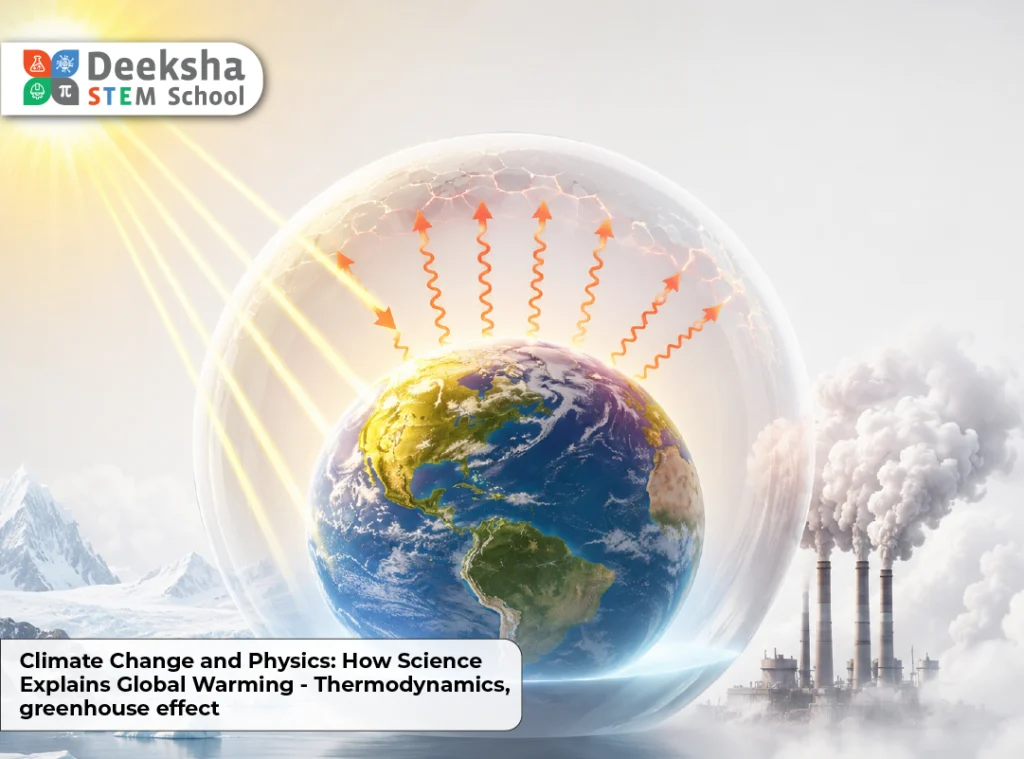
Climate change gets discussed constantly as a policy debate, a political argument, a headline. What rarely gets discussed is that underneath all of that noise sits a genuinely simple physics problem, one built on ideas most students already meet in a thermodynamics chapter: energy in, energy out, and what happens when the two stop matching.
Physics of Climate Change Students Should Actually Understand: Why This Is an Energy Problem
The physics of climate change students often meet for the first time starts with a distinction worth getting right immediately: weather and climate aren’t the same thing. Weather is what’s happening in the atmosphere on a given day, rain, wind, a heatwave, and it’s genuinely unpredictable more than a week or two out. Climate is the long-term energy balance of the entire planet, averaged over decades, and it behaves far more like a physics problem than a weather forecast ever could.
At its core, the question climate science asks is straightforward: how much energy is entering Earth’s system from the Sun, how much is leaving it back into space, and is that balance staying steady or shifting.
Global Warming Thermodynamics: The Simplest Version of the Whole Story
Global warming thermodynamics comes down to one principle most students already know: energy can’t just appear or disappear, it has to balance. Earth receives energy from the Sun mostly as visible light, and it must eventually radiate an equal amount of energy back out to space to stay at a stable temperature. That outgoing energy leaves as infrared radiation, since Earth is far cooler than the Sun and therefore radiates at longer wavelengths, a direct consequence of how blackbody radiation works.
As long as energy in equals energy out, Earth’s average temperature stays roughly constant. If something changes how much energy leaves, without changing how much arrives, the planet has to warm or cool until a new balance is reached. That single idea, an energy budget that has to balance, is the entire physics case for global warming. Everything else is really just detail about what’s currently tipping that balance.
The Greenhouse Effect Science: Why Some Gases Trap Heat and Others Don’t
The greenhouse effect science that explains this tipping point comes down to a specific, almost accidental property of certain gas molecules. Visible sunlight passes through the atmosphere fairly easily on its way in. But gases like carbon dioxide, methane, and water vapour are shaped in a way that makes them absorb infrared radiation strongly, the exact wavelength Earth radiates back out. Instead of letting that heat escape straight to space, these molecules absorb it and re-emit it in all directions, including back down toward the surface.
The result works a bit like a one-way filter: sunlight gets in relatively unimpeded, but a portion of the outgoing heat gets caught and recycled before it can leave. This isn’t inherently a problem. The natural greenhouse effect is the reason Earth’s surface averages a liveable temperature at all, rather than the frozen conditions a bare rock at Earth’s distance from the Sun would otherwise settle into. The concern isn’t that the greenhouse effect exists. It’s that adding more of these gases to the atmosphere, mainly through burning fossil fuels, increases how much outgoing heat gets caught, shifting that energy balance toward a warmer equilibrium than before.
Why a Small Gas Change Causes a Large Temperature Effect
A common, fair question: carbon dioxide makes up a tiny fraction of the atmosphere, so why would a small increase matter so much? Two things explain the outsized effect. First, even a small shift in the energy balance compounds over time, since the imbalance doesn’t correct itself instantly, it accumulates as extra stored energy year after year. Second, the climate system contains feedback loops that amplify small changes. Ice and snow reflect sunlight efficiently; as warming melts them, the darker ocean or land underneath absorbs more sunlight than the ice did, which drives further warming, which melts more ice. A modest initial shift gets reinforced by the system’s own physics, not because the original cause was dramatic, but because the system responds to change with more change.
Climate Change Physics Explanation Applied: Why Land and Ocean Warm Differently
A useful climate change physics explanation students can actually observe: land and ocean don’t warm at the same rate, and the reason is a concept straight out of a specific heat capacity chapter. Water has a notably high specific heat capacity, meaning it takes far more energy to raise its temperature by one degree compared to land or air. That’s why oceans absorb enormous amounts of extra heat while showing comparatively modest temperature rises, and why coastal regions generally experience milder temperature swings than inland areas. It’s also part of why polar regions, with far less ocean buffering and the ice-albedo feedback loop described above, tend to warm noticeably faster than the global average.
Climate Science for High School: Where This Connects to Your Physics Syllabus
Climate science for high school students maps onto material that’s already sitting in a standard physics syllabus, often without the connection ever being pointed out. Thermal properties of matter, specific heat capacity, and the basics of blackbody radiation all show up directly in how the greenhouse effect is explained. The electromagnetic spectrum, specifically the distinction between shortwave visible light and longwave infrared radiation, is exactly what determines why sunlight passes through greenhouse gases while outgoing heat doesn’t. Even the first law of thermodynamics, energy can’t be created or destroyed, only transferred or transformed, is functionally the same principle driving Earth’s entire energy balance. This isn’t a separate topic bolted onto physics. It’s an application of physics concepts already on the syllabus, just rarely connected to something this consequential.
How This Fits a Deeksha STEM Classroom
This is a genuinely good example of enquiry-based learning in action: instead of accepting “the planet is warming” as a fact to memorise, the more useful question is why, physically, that would even be possible, which leads straight back to an energy balance argument students can actually verify for themselves. Experiential science offers an unusually direct way in here too. A simple demonstration, comparing the temperature rise in two sealed containers under a lamp, one with ordinary air and one with a higher concentration of carbon dioxide, lets students observe the greenhouse effect directly rather than take it on faith. And communicative English matters in a topic this loaded with public noise: being able to explain the actual physics clearly, without either downplaying it or overstating it, is a genuinely rare and valuable skill.
FAQs
Is the greenhouse effect the same thing as the ozone hole? No, they’re different phenomena. The greenhouse effect involves gases trapping outgoing heat near Earth’s surface. Ozone depletion involves a separate chemical reaction that thins the ozone layer high in the atmosphere, primarily affecting how much harmful ultraviolet radiation reaches the surface.
How can carbon dioxide matter so much if it’s such a small percentage of the atmosphere? Its effect isn’t about total volume, it’s about how strongly it absorbs infrared radiation compared to the more abundant gases like nitrogen and oxygen, which barely absorb infrared at all. A small concentration of a strongly-absorbing gas can still shift the overall energy balance significantly.
Is the physics behind global warming considered settled science? The core mechanism, greenhouse gases absorbing and re-emitting infrared radiation, causing a shift in Earth’s energy balance, is well-established physics with a strong scientific consensus behind it. Ongoing research focuses on refining the details and predicting specific regional impacts, not on whether the basic mechanism exists.
What’s the actual difference between weather and climate? Weather describes short-term atmospheric conditions, useful for a few days out at most. Climate describes long-term average patterns measured over decades, which is why a single cold winter doesn’t contradict a long-term warming trend, the two operate on entirely different timescales.