Ask a room full of parents what career will still matter twenty years from now, and the answers cluster around the familiar ones: doctor, engineer, software developer. Sensible guesses. Also, a reminder of how badly the future resists prediction.
Rewind to the early 2000s, and nobody was building a career as an app developer or a data scientist; those job titles barely existed. Artificial intelligence lived in science fiction, not job postings. Predicting exact roles is a losing game. Understanding the forces creating new ones isn’t.
Why Emerging STEM Careers in 2026 Look Different From a Guessing Game
The common thread across this year’s fastest-growing STEM roles isn’t a single technology. It’s the fact that machines are starting to take on tasks that used to belong entirely to people. That doesn’t shrink the role of humans in these fields. It changes what’s asked of them: less repetitive execution, more judgement, design, and the ability to ask better questions.
That shift is what’s actually shaping the future STEM jobs for students graduating over the next decade — not any one skill or tool, but a different relationship between people and technology.
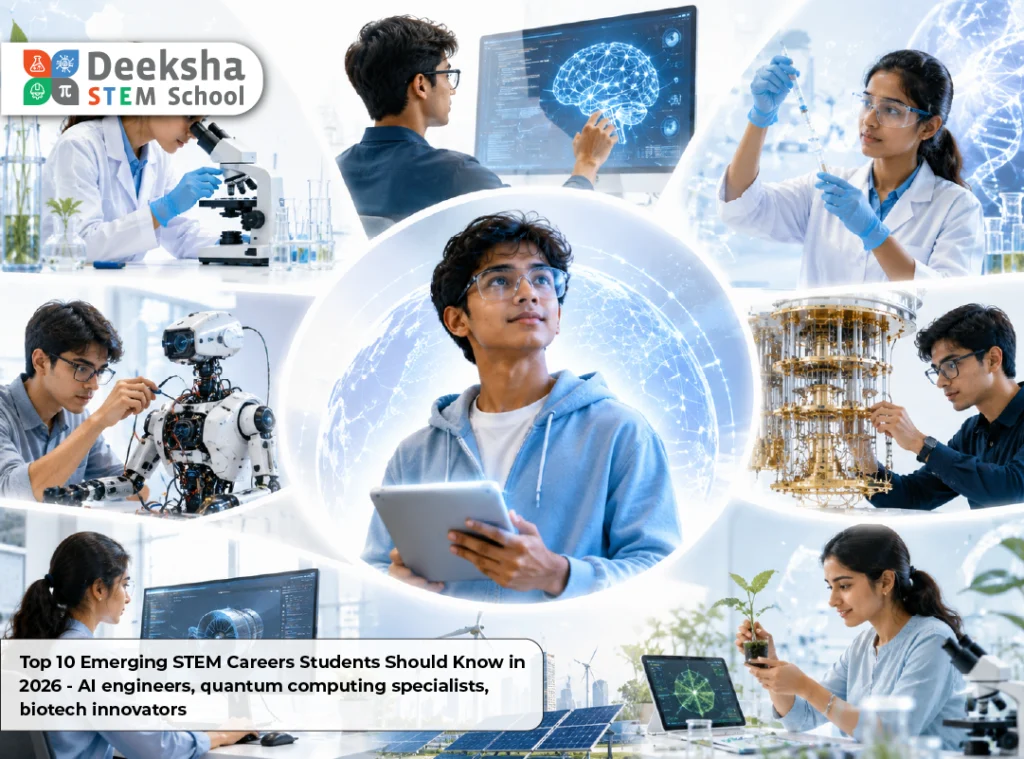
The Top 10 Emerging STEM Careers for 2026
1. AI Engineer
AI already recommends what people watch, helps doctors read scans, and flags financial fraud before it spreads. The AI engineer career path ahead isn’t just about writing models; it’s about deciding where automation should stop and human judgement should take over. That takes mathematics and programming, but also ethics and the willingness to ask “should we,” not just “can we.”
2. Quantum Computing Specialist
Quantum computing exists to answer a question classical computers can’t: what happens when a problem would take a normal machine thousands of years to solve? It’s still early, which is exactly why students building strong foundations in physics and computational thinking now could be positioned for quantum computing jobs that don’t fully exist yet, in medicine, cybersecurity, and materials science.
3. Biotechnology Innovator
Some of the next decade’s biggest breakthroughs won’t come out of a software company; they’ll come from a lab growing disease-resistant crops or developing personalised medicine. A biotech career for students who like asking how science improves daily life sits at the intersection of biology and engineering, and it’s growing faster than most school career-counselling sessions acknowledge.
4. Robotics Engineer
Forget robots welded behind factory fences. Today’s robots assist surgeons mid-procedure, inspect bridges humans can’t safely reach, and search disaster zones. Designing them takes engineering fundamentals, but also the kind of iterative, build-test-rebuild thinking that doesn’t show up in a textbook definition.
5. Climate Technology Engineer
Climate change has become an engineering brief, not just an environmental one. Cleaner energy, smarter buildings, better battery storage — the students designing these systems today could be the ones cities depend on in fifteen years.
6. Cybersecurity Specialist
Every connected device is also a point of risk. As hospitals, schools, and banks lean further into digital systems, cybersecurity work becomes less optional and more foundational, quiet, largely invisible work that modern life increasingly depends on.
7. Data Scientist
Collecting data stopped being the hard part years ago. Knowing what it means is the actual skill. Good data scientists combine technical fluency with the instinct to ask the right question of a dataset.
8. Space Systems Engineer
Space isn’t government-only territory anymore. Private companies are launching satellites, building reusable rockets, and opening entirely new categories of work. For students drawn to physics and exploration, the field is wider than it was for their parents’ generation.
9. Renewable Energy Engineer
Every country is chasing cleaner, more reliable power. That’s created sustained demand for engineers who can improve solar efficiency, wind infrastructure, storage systems, and smart grids, a field where the impact of good work shows up quickly and visibly.
10. Human-AI Interaction Designer
As AI moves into classrooms, offices, and homes, someone has to design how people actually interact with it — trust it, understand it, correct it when it’s wrong. This role blends psychology, design, and technology, and it’s one of the newest, most overlooked paths on this list.
What These Careers Actually Have in Common
Line them up and a pattern shows up that has nothing to do with subject choice. Some of these careers lean on mathematics, others on biology or design — but every one of them rewards curiosity, adaptability, and the willingness to keep learning past the point where the syllabus ends.
| Career | Leans on | Skill worth building now |
| AI Engineer | Math, programming | Asking “why” a model made a decision, not just building it |
| Quantum Computing Specialist | Physics, computational thinking | Comfort with abstract, non-intuitive problems |
| Biotechnology Innovator | Biology, chemistry | Designing and running an actual experiment, not just reading about one |
| Data Scientist | Statistics, communication | Explaining a pattern in plain language |
| Human-AI Interaction Designer | Psychology, design | Noticing how people actually behave, not just how they should |
Asking a ten-year-old what they want to become is usually the wrong question; it’s nearly impossible to answer honestly at that age. A better one: what kind of problems do they enjoy solving? Job titles change. That instinct tends to stay.
What Schooling Needs to Look Like for This
Preparing students for roles like these isn’t about teaching a new programming language every couple of years. By the time today’s Class 6 student graduates, several of today’s tools will already look dated.
The more durable investment is building confident learners: students who ask real questions, test their own assumptions, and can explain what they’ve figured out. At Deeksha STEM Schools, that shows up directly in how classrooms run. Enquiry-based learning is what builds the habit an AI engineer needs — questioning a system’s output instead of accepting it. Learning by design is what a robotics or climate tech career actually looks like day to day — build, test, find what breaks, rebuild. Experiential science is the closest a school gets to the actual work of a biotechnology innovator: run the experiment, don’t just read about someone else’s. And communicative English matters more than it looks — a data scientist or a cybersecurity specialist is only as useful as their ability to explain a finding clearly to someone who isn’t technical.
None of these are electives bolted onto STEM. They’re the version of STEM that produces people ready for careers that haven’t been invented yet.
The Bigger Question
Nobody can list the ten most in-demand jobs of 2045 with any real accuracy; history says several of today’s confident predictions will be wrong. What’s possible is preparing students to meet whatever that list turns out to be with curiosity intact and the ability to keep learning. In a field that moves this fast, that may be the only future-proof skill there is.
FAQs
What subjects should I focus on for an AI engineer career path? Strong mathematics (especially statistics and linear algebra) and programming fundamentals matter most, but the differentiator is usually the ability to reason about a system’s decisions, not just code one.
Are quantum computing jobs only open to physics students? Physics helps, but quantum computing careers also draw heavily from mathematics and computer science ,computational thinking matters as much as the physics itself.
How can a school student start exploring a biotech career? Hands-on lab work and experiment design at the school level matter more than early specialisation. The habit of running and interpreting an experiment transfers directly to biotech research later.
Is it too early to think about emerging STEM careers 2026 in middle school? It’s too early to pick one. It’s not too early to build the underlying habits, curiosity, comfort with ambiguity, and clear communication, that most of these careers share.